

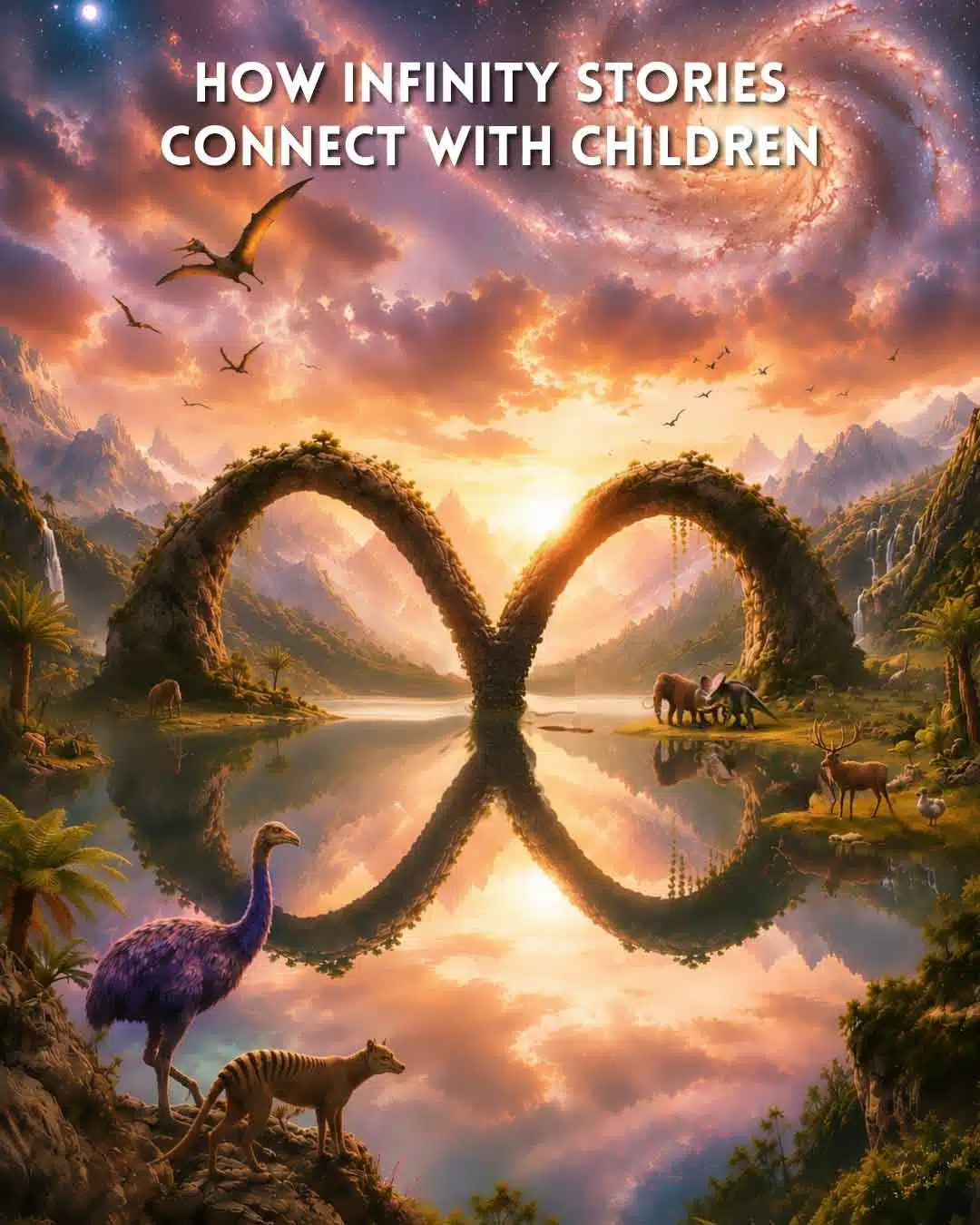
 ‘Lost on Infinity’ has always been a story about difference, nature and belonging.
On the Island of Infinity, the last one of every extinct animal species lives. Each creature is unique. Some are strange, some are funny, others are frightened, and a few are brave. Yet all of them matter.
That idea has always been at the heart of our stories.
Over the years, parents, teachers and autistic listeners have told us they have found something special in our stories. And the same few reasons come up again and again. First, a world where being different is accepted, not judged. Second, a fantasy with its own clear internal logic, full of detail, pattern and meaning. Then there are the songs and sounds that reward listening over and over. Above all, there are many different ways into the story, from audio and music to pictures, animation and books.
Some have loved the story world, while others have connected with the characters. Many have played the songs again and again. And a few have told us the music simply helps them relax after a long day.
That means a great deal to us.
Why does the Island of Infinity speak to so many children?
Fantasy worlds work best when they have strong internal logic.
Children often understand this better than adults. They know when a made-up world feels real, when a character belongs, and when a story is trying too hard.
Infinity has its own rules and its own history. There is the Fossil Record Office, along with lost creatures, secret messages, and a boy and his dog trying to make sense of it all.
For children who enjoy detail, pattern, music and meaning, that can be powerful.
The Island of Infinity is not a noisy jumble of random fantasy ideas. Instead, it is a world built around one clear thought.
Every creature matters.
Very young children can understand that message. It can stay with adults too.
“My daughter is at the age where fantasy is very real to her, and she likes the internal logic of fantasy worlds to make sense. She has been completely inspired by Rockford, and I enjoy being carried along with her imagination. She does an excellent impression of the Registrar, by far her favourite character. She sings along and forces her little brother to sing the ‘oh deary me’ bits. She also introduced Rockford to her autistic American cousin, who really enjoyed the music. You’ve created something really special here. It’d make a wonderful school production. Thank you.” Susan, UK
No judgement on Infinity, just acceptance
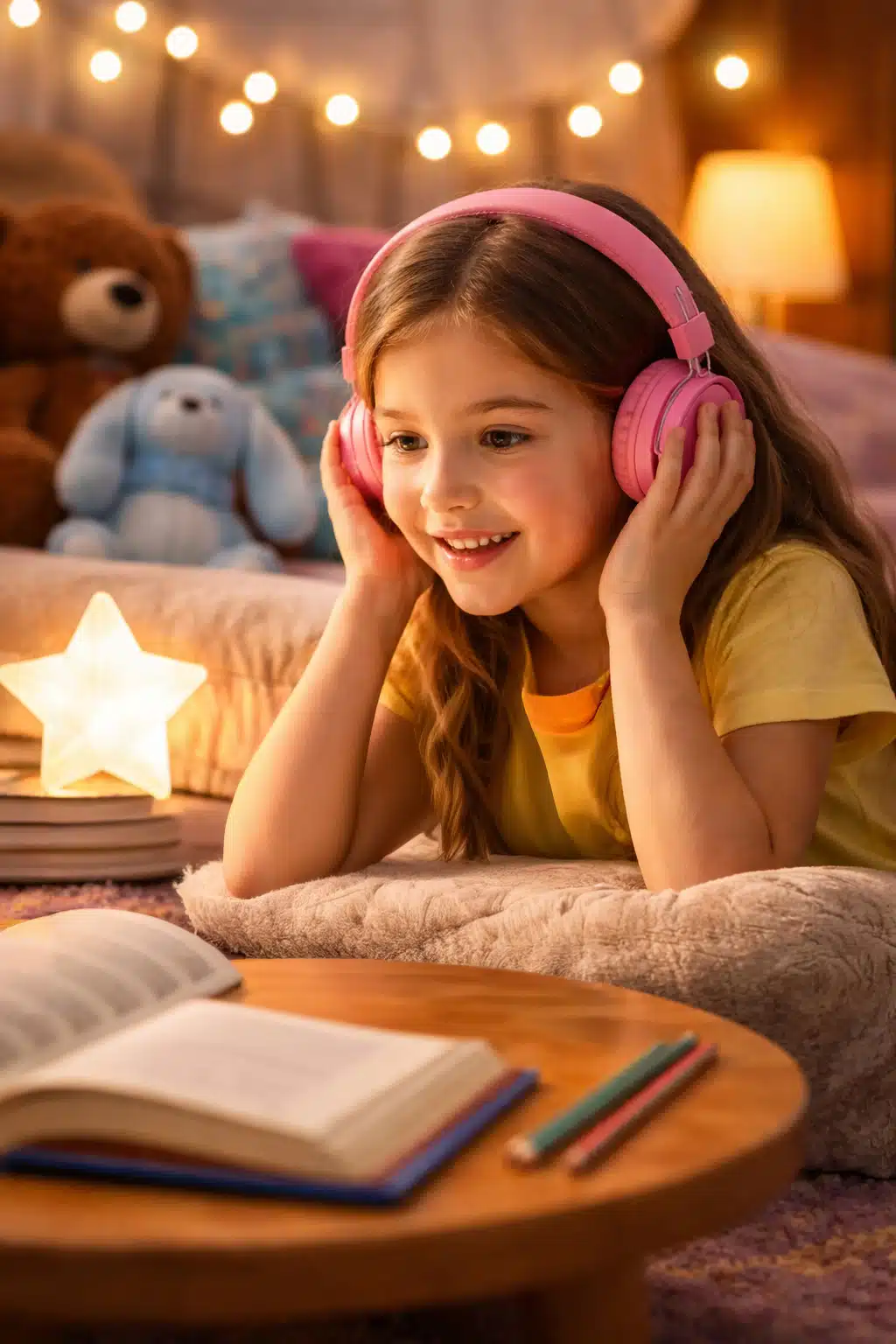
The Island of Infinity never judges difference. Instead, it simply accepts it.
The last creatures of every extinct species live there together. They may be strange, shy, loud, lonely, funny or fierce, but they all have a place. Infinity does not ask them to become something else. Rather, it gives them room to be themselves.
That idea runs right through Rockford’s Rock Opera. In The King of Nowhere, for example, the Herd wander together, helping animals find their happy place, or their true home. It is a gentle but powerful idea: everyone needs somewhere they feel safe, understood and accepted.
For many autistic listeners and families, this may be part of the emotional connection. After all, the stories never lecture. They do not tell children how to be. Instead, they create a world that sees unusual characters, values them, and helps them find where they belong.
Infinity says: there is room for you here.
Not because you are the same as everyone else.
Because you are yourself.
“I can’t even explain how awesome this was to find. My son has autism and has been obsessed with this for years. This made my son’s year! When he opened the package, he smiled so big and said ‘finally!’” Michelle, Amazon book review
Biomimicry is at the heart of Infinity
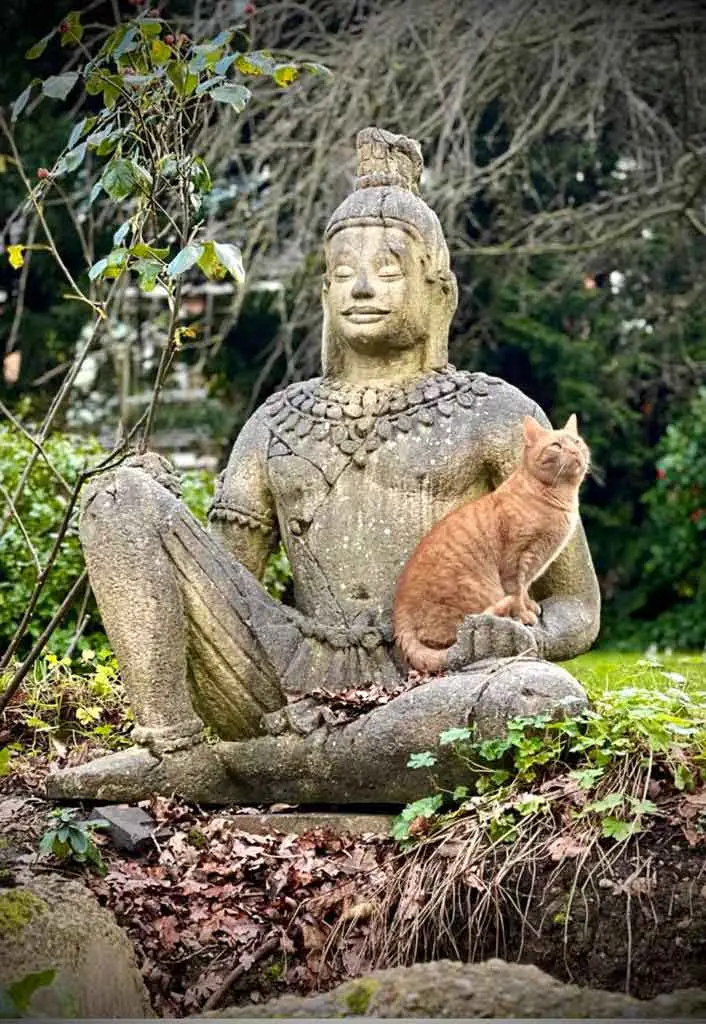 There is another idea at the heart of Rockford’s Rock Opera too: biomimicry.
In Lost on Infinity, Herc tells us, “Every creature has a secret.”
That is one of the most important ideas in the story. Every animal, plant and life form has something to teach us – a design, a skill, a survival trick, or a clever way of solving a problem.
That, in short, is what biomimicry means: the science of learning from nature’s ideas.
For us, this links beautifully with the deeper message of Infinity. Every creature is different. Each one has value. And each carries knowledge that could help the world.
So when we lose a species, we do not only lose something beautiful. We may also lose a secret we never had the chance to understand.
You can explore more about biomimicry and nature’s hidden ideas on our Biomimicry page and in our Creatures’ Secrets Database.
The power of music, rhythm and repetition
Rockford’s Rock Opera is not just a story. It is a musical story world.
There is narration, character voices, sound effects and original songs. That mix can be hugely appealing to listeners who enjoy sound, rhythm and repeated listening.
Many families tell us they play the songs again and again. In fact, that does not surprise us. Songs can become familiar places. A chorus can feel like a safe path through a story, and a repeated phrase can be funny, comforting and grounding.
One listener told us the story helps them relax before bed. Others say the music has become part of family life.
“Gorgeous and very well written. Relatable characters, an important lesson told through the magic of narration, animation and of course catchy rock music! The art style is very consistent, and the 3D animated scenes are so fluid and entertaining to watch. I can see how much love was poured into this. I’m 26 and autistic, and it helps relax me before bed.” Brionna Knapp
Indeed, that is one of the great strengths of audio storytelling. Children do not have to sit still with a book. Instead, they can listen while drawing, resting, travelling or winding down.
So for some autistic children, that can make a story far easier to access.
Read along: hear the words and see them too
Reading can feel like hard work for some children. After all, decoding every word on your own is tiring, and it can take the joy out of a story.
That is why we built Lost on Infinity as a read-along. Children can follow the words on the page or screen while the free musical audiobook reads them aloud, so they see and hear the story at the same time.
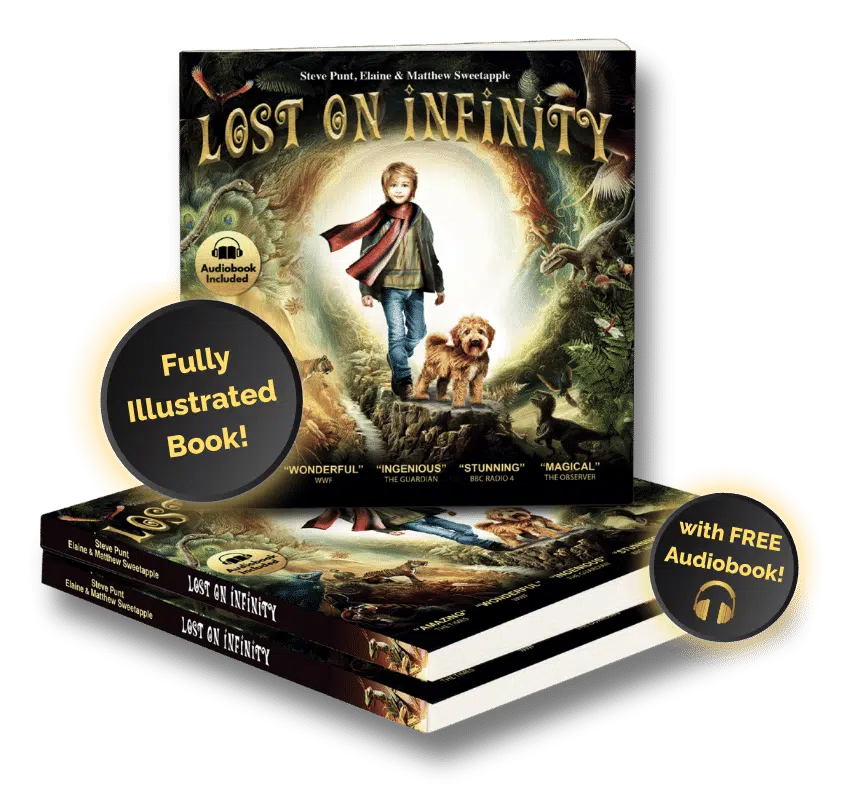
| Three ways to read along:
Kindle — read and listen at the same time, with the free audiobook included. App — the full read-along storybook, with audio (Apple) Paperback — the illustrated book, with its free audiobook included. |
Reading and listening at once can make a real difference. For a reluctant reader, it helps them stay with a story they might otherwise give up on. Children with dyslexia often find it easier to follow words when they hear them at the same time. Meanwhile, those who struggle to concentrate get sound, rhythm and pictures to hold onto. And for children learning English, it becomes a gentle, enjoyable way to build vocabulary and confidence.
“Amazing graphics! I downloaded this for my autistic son because just reading from a book gets boring sometimes. After the first part I couldn’t wait to see the second part! My son loves it! We both do! I would love to see more of these stories. This deserves a 10!” App review
As a result, no child has to feel they are behind. They simply enjoy the story in whatever way works best for them.
You can find all the read-along formats here: the musical adventure story.
Why the infinity symbol feels so meaningful
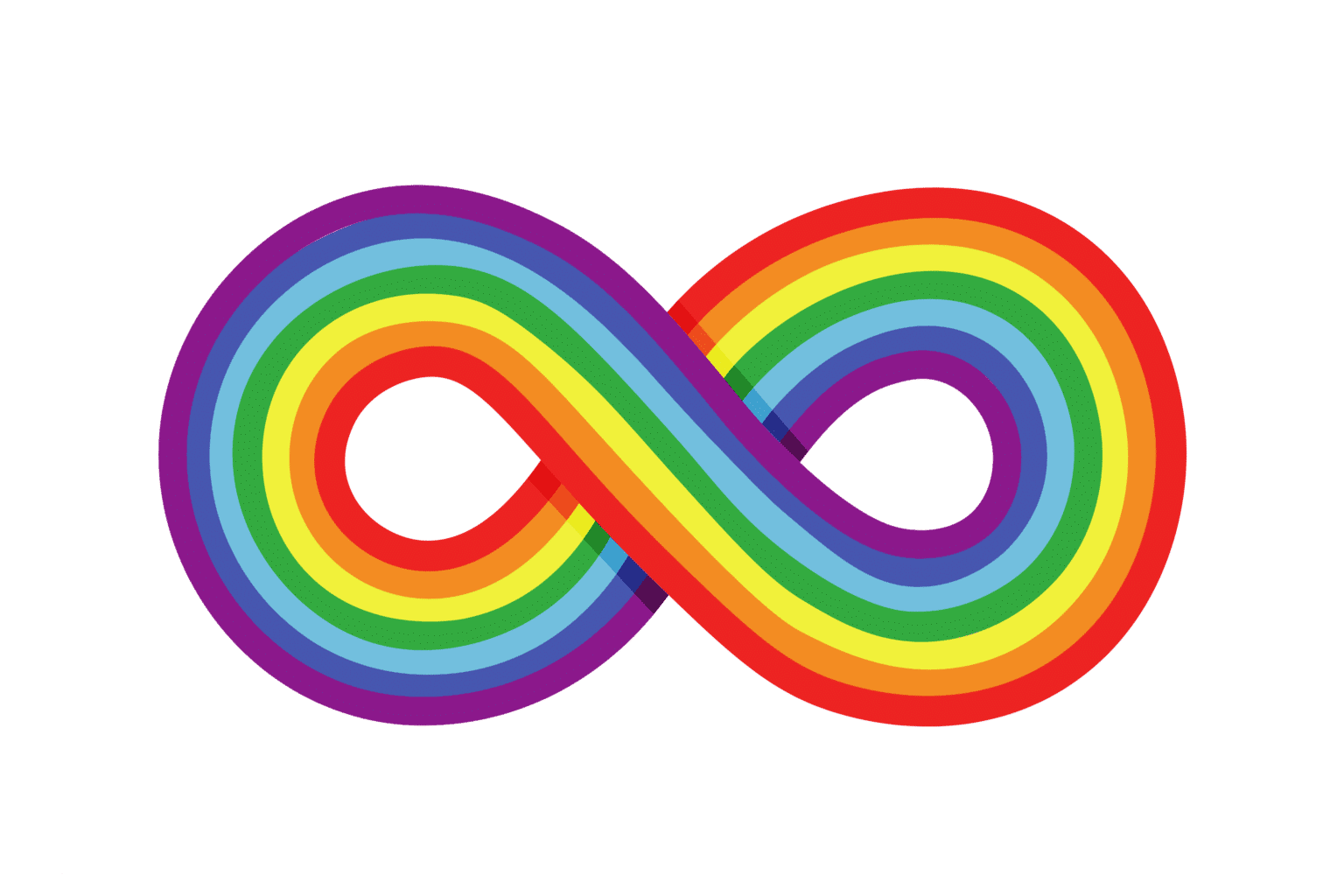 Today, many people in neurodiversity and autistic community contexts use the infinity symbol. For us, that feels like a happy coincidence.
When we created the Island of Infinity, we were thinking about extinction, memory, nature and belonging. Yet the idea of Infinity has always carried a deeper meaning in our story world. After all, it is a place where every creature is different, every creature matters and no life is forgotten.
Visually, our Island of Infinity also holds the shape of the infinity symbol. Its two arches, their reflections on the water and their shadow on the ground create that form.
It feels special that a symbol so close to the heart of our story also carries meaning for a community that has connected so warmly with Rockford’s Rock Opera.
Inclusive storytelling matters
Educators have also recognised Rockford’s Rock Opera in inclusive learning contexts.
In fact, the stories now feature in discussions of transmedia storytelling in education. That simply means using different forms — audio, music, animation, apps, books and classroom activities — to help children enter a story world in more than one way.
And that matters.
Not every child learns by reading a page in silence. Some learn through sound, others through movement or pictures. Many need repetition. And for a few, an emotional connection has to come before any information makes sense.
As a result, a musical story can open more doors.
Of course, that does not mean it works for every child. Nothing does. But it does mean Rockford’s Rock Opera can offer a rich and flexible way into big ideas: extinction, ecology, friendship, difference, belonging and biomimicry.
 A story that meets children where they are
 A story that meets children where they are
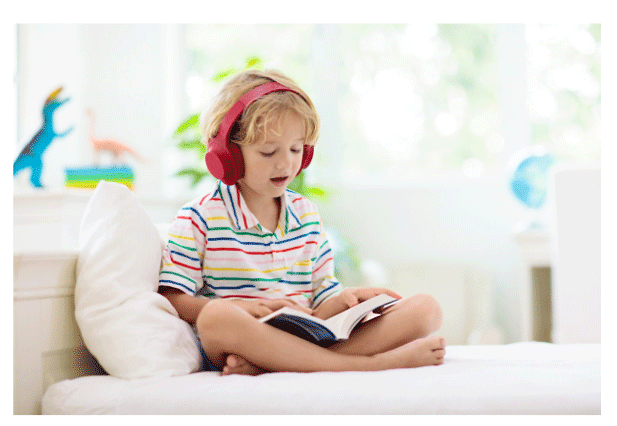
One of the loveliest things about Rockford’s Rock Opera is that children can meet it in their own way.
They can listen to the audiobook, follow the story with pictures, or sing the songs. There is also the animated adventure to watch, the free teaching resources to explore, and favourite characters to return to again and again.
For some children, the music comes first. Others fall for the animals, or for the logic of Infinity itself. And for a few, it may simply be the feeling of entering a world where oddness is not only allowed, but loved.
That is a rare thing.
Different is not less
We created Rockford’s Rock Opera to help children care about the natural world. But we also wanted it to make them feel something.
We wanted children to care about extinct animals, and to understand that losing a species is not just a scientific fact. It is a story ending too soon.
But over time, listeners have shown us something else.
The Island of Infinity also helps children think about difference, identity and belonging.
The last creatures of Infinity are not ordinary. That, in fact, is the point.
They are unforgettable precisely because they are different.
“I’ve been retired 11 years, but one of my best memories was an autistic teenager,
who’d found it hard to attend assemblies in our complex needs school — performing
‘I Am The Registrar’ solo, word and pitch perfect. Amazing.” K Luck
And perhaps that is why so many autistic listeners and families have found a home in the story.
______________________________________________________________________
Discover more through our ecological adventure stories
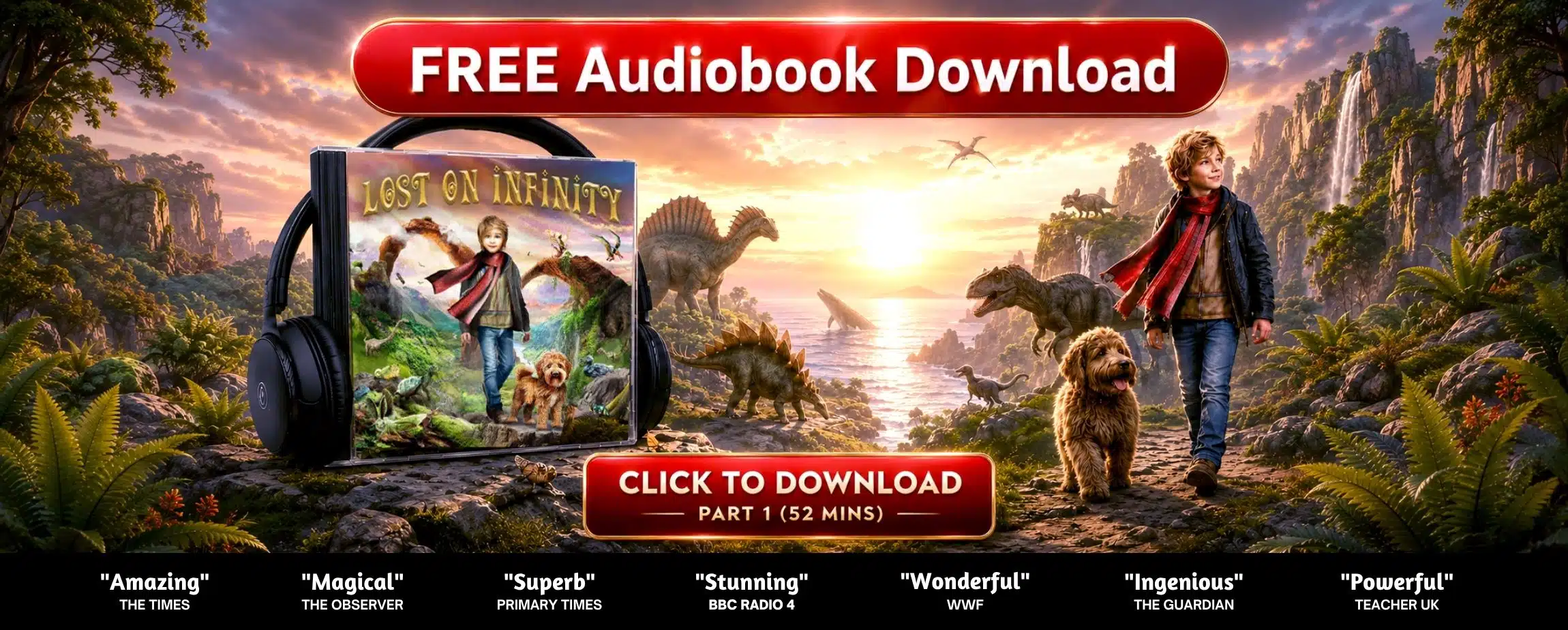
Lost on Infinity is a musical adventure story that introduces children to extinction, biodiversity and biomimicry through storytelling and original songs.
Get the Lost on Infinity illustrated book with free musical audiobook – a totally immersive experience.
Listen to the first part of the Lost on Infinity audiobook and watch the animated adventure FREE on Apple App Store and Google Play.
Download our FREE lesson plans and slides about Extinction and Biomimicry. We also have a selection of FREE classroom activities on our website.
For even more exploration of the natural world, tune in to our Stories, Science & Secrets podcast for kids. Join Matthew, Elaine, Steve Punt and special guests, as we delve into the fascinating world of biomimicry and the inspiring ways science learns from nature’s genius.
Every creature has a secret, and every life is precious.
______________________________________________________________________
About the creators:
Steve Punt is a writer and broadcaster, known for his work across BBC radio and television, and co-creator of Rockford’s Rock Opera.
Matthew Sweetapple is a writer and producer of Rockford’s Rock Opera, focusing on adventure-led environmental narratives.
Elaine Sweetapple is an illustrator and co-creator of Rockford’s Rock Opera, writing about nature, biomimicry, and storytelling.
Rockford’s Rock Opera adventures are written by professional writers, illustrated by artists, and recorded by real musicians, actors and producers. Crafted by humans, the hard way 🎶😊💚