

The strange exchanges taking place under our feet and above our heads
Walk through a wood and most of the activity seems to be above ground. Leaves move in the wind, birds sing in the branches and insects make their way across the bark.
Yet much of a forest’s business happens out of sight.
Tree roots form partnerships with fungi. Plants release chemicals when animals or insects attack them. Some trees even become physically joined beneath the soil.
Scientists often describe these exchanges as communication. Trees don’t have thoughts or conversations as we understand them, but they do react to information from their surroundings and sometimes from other plants.
What is the ‘Wood Wide Web’?
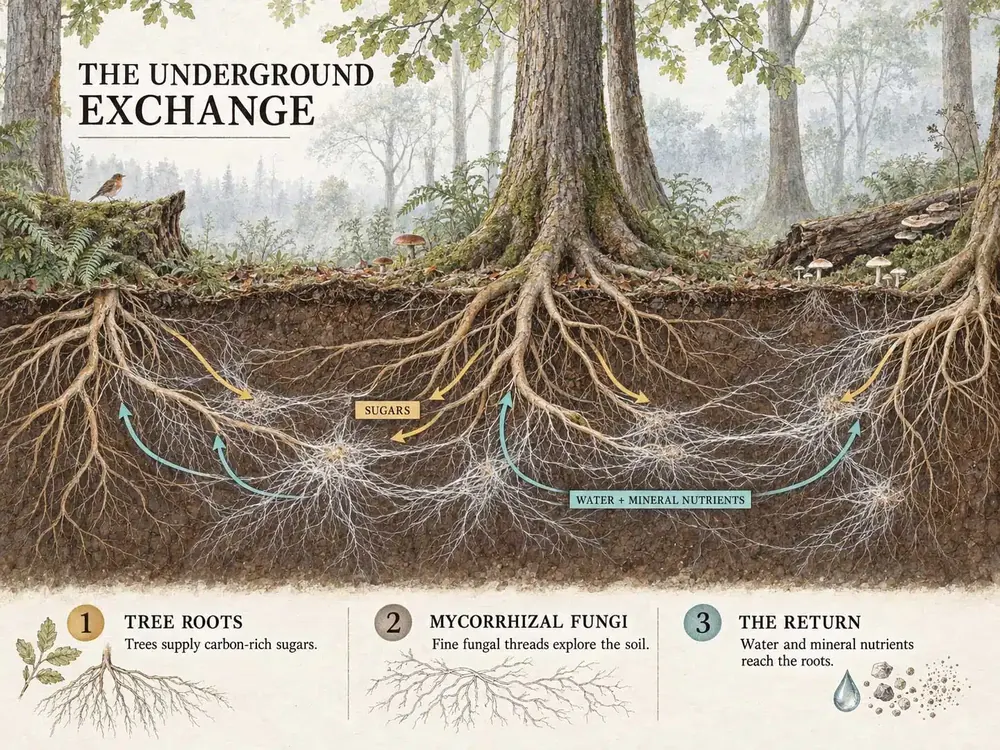
Most trees form close relationships with fungi that live around or inside their roots. These are called mycorrhizal fungi. The word “mycorrhiza” comes from the Greek words for fungus and root.
The partnership is like a trade.
A tree produces sugars from sunlight through photosynthesis. It passes some of these carbon-rich sugars to the fungus. In return, the fungus helps the tree obtain water and mineral nutrients from the soil, including phosphorus and nitrogen.
Fungal threads, known as hyphae, are much finer than tree roots. They can grow into tiny spaces in the soil that roots can’t reach.
Some fungi associate with more than one plant. This creates what scientists call a common mycorrhizal network. The more memorable name, coined by the journal Nature, is the “wood wide web”.
In a well-known experiment published in 1997, researchers detected carbon moving between paper birch and Douglas fir trees associated with mycorrhizal fungi. Other studies have detected nutrients and chemical signals moving between connected plants.
It is tempting to picture an underground internet with trees sending messages and food parcels to their friends. The evidence doesn’t go quite that far.
Scientists still don’t know how common these connections are in mature forests or how much material moves from one tree to another. It isn’t always clear whether the fungus, the tree or simple differences in concentration control that movement.
A 2023 review of the evidence warned that some claims about the ‘wood wide web’ have been repeated far more confidently than the research allows.
Something is certainly happening under the forest floor. We just haven’t worked out all the rules yet.
Can plants send warnings underground?
Experiments suggest that fungal networks may carry information about danger.
Researchers allowed broad bean plants to become connected by mycorrhizal fungi. They then placed aphids on one of the plants.
The plants connected to the attacked plant began releasing defensive chemicals. These made them less appealing to aphids and more attractive to parasitic wasps, which prey on aphids. Plants without a fungal connection didn’t respond in the same way.
The researchers had separated the plants carefully so the signal couldn’t have passed directly through the soil or air. Their results suggested that something had travelled through the fungal connection.
We still can’t say that the attacked plant deliberately warned its neighbours. The neighbouring plants may have detected and used information entering the network. Either way, the experiment revealed an unexpectedly quick connection between plants.
How do acacia trees respond to giraffes?
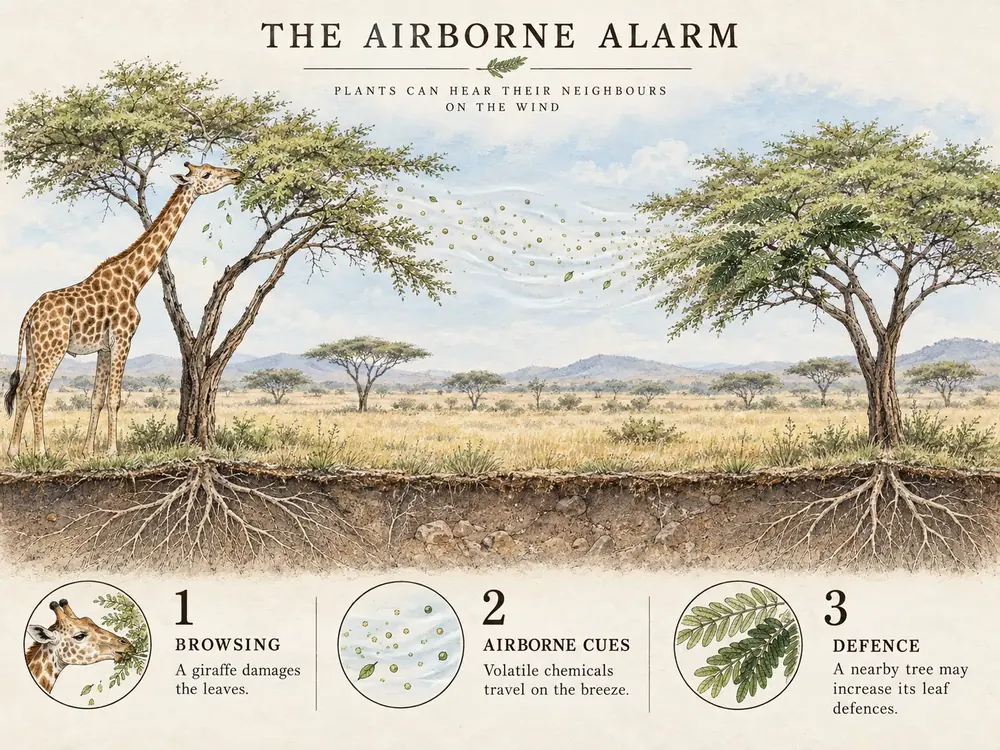
Some tree warnings travel through the air.
Giraffes feed on several African trees traditionally called acacias, although botanists now place many of them in the genera Vachellia and Senegalia.
When a giraffe bites into the leaves, the damaged tree can increase its production of defensive chemicals called tannins. These make its leaves bitter and harder to digest.
There is evidence that damaged plants also release volatile chemicals. These chemicals are carried on the wind and may prompt nearby plants to prepare their own defences.
The much-repeated version of the story says that acacia trees release ethylene gas to warn one another that giraffes are coming. That wording isn’t quite right. The tree first has to be damaged. It isn’t spotting a giraffe in the distance.
The involvement of ethylene is widely reported from older South African research, but the original evidence is harder to verify than many online accounts suggest. What scientists can show is that browsing changes acacia chemistry and that plants can react to airborne chemicals released by damaged neighbours.
Giraffes have also been observed feeding into the wind. One possible explanation is that this allows them to reach trees that haven’t yet received airborne signals from those already browsed.
The acacia and giraffe are locked in a long-running evolutionary contest. Giraffes have height, long tongues and tough mouths. Acacias answer with thorns and chemical defences. Neither side gets everything its own way.
Read more on our previous blog: Whispering Trees and the Clever Giraffes
The tree stump that was still alive
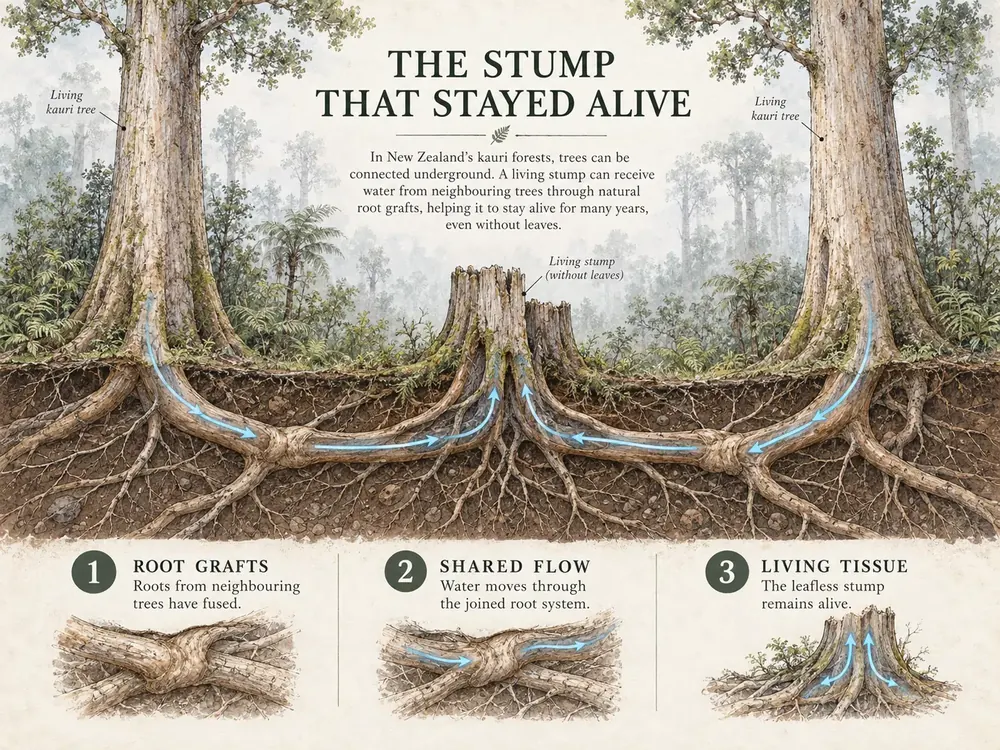
In a New Zealand kauri forest, two researchers found a stump that appeared to have been dead for years.
It had no leaves, so it couldn’t make sugars through photosynthesis. Yet living tissue remained beneath its bark and water was still moving through it.
The researchers discovered that the stump’s roots had become physically joined to the roots of neighbouring kauri trees. Such connections are called natural root grafts.
Measurements showed that the stump’s water flow was closely linked to the activity of the surrounding trees. Water could enter it through the joined root system, although its daily pattern was different from that of a normal tree.
The researchers couldn’t tell whether the neighbouring trees gained anything from keeping the stump alive. The roots may have fused while all the trees were healthy and simply remained connected after the original trunk was lost.
The 2019 study gives us a reason to reconsider where one tree’s root system ends and another begins.
Why do trees sometimes produce seeds together?
Anyone who lives near oak or beech trees may notice that some autumns are much seedier than others.
During a mast year, trees across a large area produce an unusually heavy crop of acorns, nuts or seeds. Leaner years may follow.
The trees aren’t arranging this through the fungal network. Their seed production can become synchronised because they respond to similar weather conditions and because flowering trees exchange pollen. They must also build up enough energy to produce a large crop.
One benefit may be sheer quantity. Birds, mice and other animals can eat most of the seeds in an ordinary year. During a mast year there may be more food than the local animals can possibly consume. Some seeds therefore escape and have a chance to grow.
Mast years can alter animal populations too. More seeds can mean more rodents, which can affect the predators that feed on them. The effects can continue long after the last acorn has fallen.
Scientists are still studying what triggers masting and why its timing varies between species. The Royal Society describes it as intermittent, synchronised seed production with consequences for plants and the animals around them.
What does this have to do with farming?
Mycorrhizal fungi associate with many agricultural plants as well as forest trees.
They can improve a plant’s access to nutrients, especially phosphorus. Their possible use in agriculture and forestry has been studied for decades. The research paper linked here was published in 1984, so this isn’t a new farming idea.
Some modern farming practices can disturb these fungi. Ploughing breaks up fungal threads. Leaving soil without suitable living plants removes their supply of sugars. Heavy fertiliser use can change the bargain because crops have less need to obtain nutrients through fungal partners.
Reduced tillage, varied crop rotations and cover crops may help mycorrhizal communities survive. The results depend on the crop, the soil and local conditions. Buying a commercial fungal treatment isn’t guaranteed to improve a field.
Sometimes the useful fungi are already there. They mainly need a chance to remain there.
A different way to see a forest
We often look at a tree and see a single living thing with a clear beginning and end.
Underground, that distinction becomes rather less tidy. A tree may be exchanging resources with fungi, detecting signals from another plant or sharing a physical root connection with its neighbour.
Trees have no brains and no known awareness of what they are doing. Their responses have developed through evolution because, in certain circumstances, those responses helped them survive and reproduce.
That doesn’t make the real story disappointing. It makes a patch of woodland far busier and stranger than it looks from the path.
On the Island of Infinity, every creature depends on other forms of life. Our own forests are built on the same principle, although most of the connections are hidden beneath our feet.

Discover more through our ecological adventure stories
Lost on Infinity is a musical adventure story that introduces children to extinction, biodiversity and biomimicry through storytelling and original songs.
Get the Lost on Infinity illustrated book with free musical audiobook – a totally immersive experience.
Listen to the first part of the Lost on Infinity audiobook and watch the animated adventure FREE on Apple App Store and Google Play.
Download our FREE lesson plans and slides about Extinction and Biomimicry. We also have a selection of FREE classroom activities on our website.
For even more exploration of the natural world, tune in to our Stories, Science & Secrets podcast for kids. Join Matthew, Elaine, Steve Punt and special guests, as we delve into the fascinating world of biomimicry and the inspiring ways science learns from nature’s genius.
Every creature has a secret, and every life is precious.