

Technology giant, Microsoft, is turning to nature for ideas about how the huge data centres behind our increasingly digital world can work more closely with the ecosystems around them. The company calls the approach ‘biomimicry’, and it is now expanding the programme to more than 20 data-centre sites across the USA and Germany. For us at Rockford’s Rock Opera, this is particularly exciting news. We have been telling children about biomimicry, and the extraordinary secrets hidden in nature, for nearly 20 years.
Before we begin
Before we begin, we have to note that data centres and AI raise difficult questions about energy, water and their effect on the natural world. In this article, we’re simply reporting how Microsoft is studying nature to help design future data centres. So although we’re pleased to see a major technology company learning from living systems, we also recognise that the future Microsoft imagines could place further pressure on the planet. AI may also help scientists find new ways to tackle environmental problems. There are benefits, risks and unanswered questions on both sides, which deserve an article of their own.
What can we learn from nature?
When we first created the stories of Infinity nearly 20 years ago, biomimicry was right at the heart of them.
Infinity is home to the last one of every extinct animal species. Behind the fantasy was an idea that fascinated us then and fascinates us even more today.
Every time a species disappears, we risk losing one of nature’s secrets before we have even discovered it.
Every animal, plant and ecosystem is the result of millions of years of evolution. Nature has found extraordinary ways to fly, swim, build, cling, communicate, stay cool, repel water, resist infection and survive in some of the most difficult places on Earth.
What if one of those solutions could help us solve a human problem?
That question is at the heart of biomimicry. Scientists, engineers, architects and designers study how nature solves problems, then try to apply those ideas to human inventions.
It also gives us another powerful reason to protect wildlife.
A species may disappear before we have understood the extraordinary chemistry in its body, the structure of its skin, the way it moves, the substances it produces or the relationship it has with other species.
Once that living species is gone, the opportunity to study it properly may be gone too.
By saving other species, we may ultimately be helping to save ourselves.
Turning children into nature detectives
This was a message we wanted to get out from the very beginning of Rockford’s Rock Opera.
We wrote about biomimicry. We talked about it in schools. We performed our stories at venues across the country and watched children become fascinated by the idea that animals and plants might hold answers to problems humans had not yet solved.
What we particularly loved was the way children responded to it.
Stories about extinction and environmental damage can understandably feel gloomy. Biomimicry gave children something positive they could actually do.
Observe. Ask questions. Look more closely. Discover.
A child could look at a feather, a leaf, a beetle, a shark or even a burr stuck to their jumper and ask:
“What can we learn from this?”
Suddenly, going outside becomes a scientific investigation.
Our Creature Secrets pages now contain more than 100 examples for children, families and classrooms to explore, and we are constantly finding more.
And we don’t have to harm nature to learn from it
One of the most hopeful parts of modern biomimicry is that scientists can often study nature without damaging it.
High-speed cameras can record movement that is too fast for our eyes to see. Microscopes can reveal structures thousands of times smaller than we can see normally. 3D scanning, photography and computer modelling can help scientists understand shapes and structures. Engineers can then reproduce those ideas using completely different materials.
The animal or plant carries on doing what it has always done.
We simply pay closer attention.
Shark skin: surfaces that bacteria struggle to colonise
Take a look at shark skin under a microscope and you will find that it is covered in tiny tooth-like structures called dermal denticles.
Scientists have studied the patterns and ridges on shark skin and created artificial surfaces inspired by them. Research has found that certain sharkskin-inspired patterns can make it harder for bacteria to attach and form biofilms. Shark skin has also inspired research into surfaces designed to reduce drag through water.
The shark gets to keep its skin exactly where it belongs.
We copy the idea.
Lotus leaves: the secret of self-cleaning surfaces
Then there is the lotus leaf.
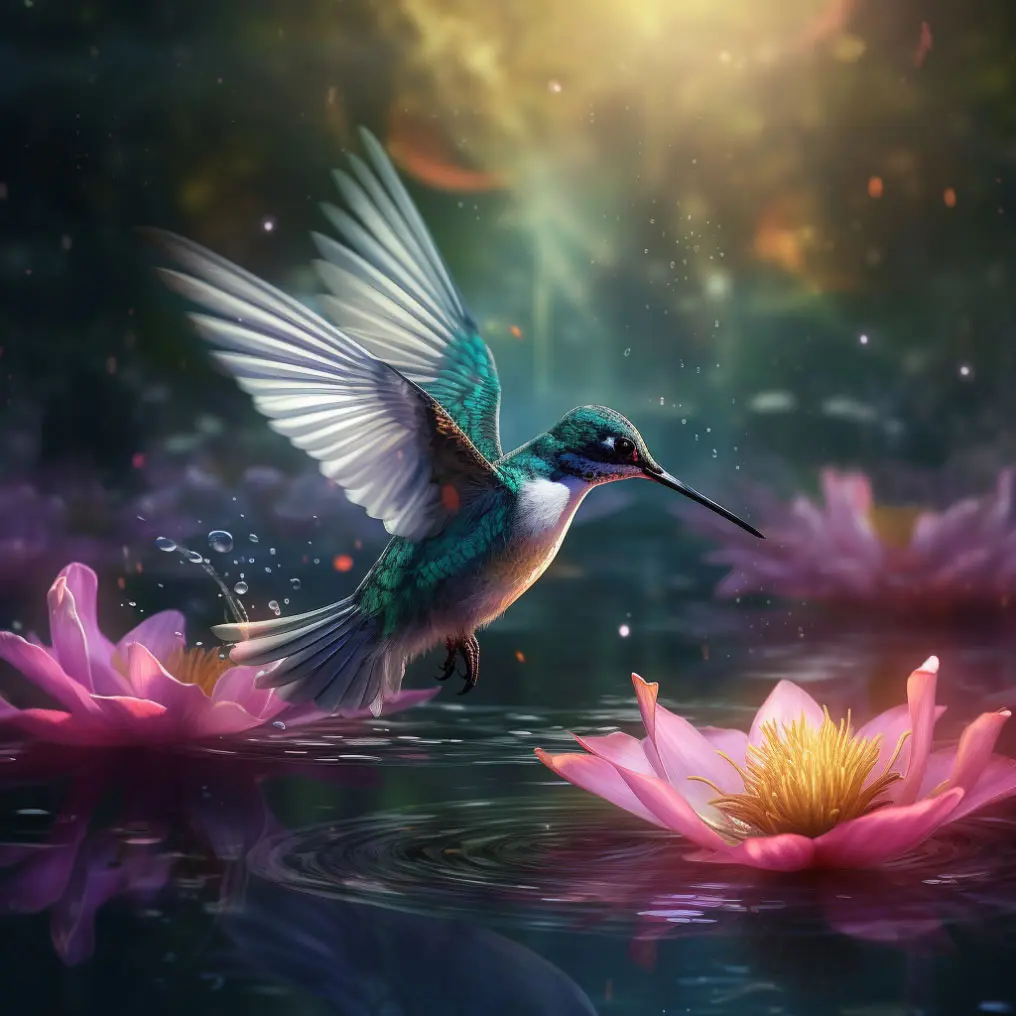
Lotus plants can grow in muddy water yet their leaves remain remarkably clean.
Look very closely and you discover why. The surface contains microscopic structures together with a waxy coating that make it extremely water-repellent.
Instead of spreading across the leaf, rain forms droplets. As the droplets roll away, they collect dust and dirt with them.
This phenomenon is known as the lotus effect.
Scientists and manufacturers have copied the principle when developing self-cleaning glass, paints, coatings and other materials.
No need to invent a complicated cleaning system. Nature has already spent millions of years working on the problem.
Woodpeckers: nature can surprise us too
Woodpeckers give us an even more interesting lesson.
For years, their heads were widely described as having special shock-absorbing structures that protected their brains while they hammered their beaks against trees. This idea even inspired engineers investigating helmets and impact-resistant materials.
But scientists kept looking.
In research published in Current Biology in 2022, scientists used high-speed recordings of living woodpeckers and biomechanical models to study exactly what happened when they pecked.
They found something surprising.
The woodpecker’s skull did not appear to work like a shock absorber. Instead, its head behaved more like a very stiff hammer. Absorbing the impact would actually make the bird less effective at hammering into wood.
The research suggested that the bird’s small brain and other features allow it to cope with the forces involved.
That is science at its best.
We observe nature. We develop an idea. Then we look more closely and sometimes nature tells us we were wrong.
There are still secrets waiting to be discovered.
So what is Microsoft doing with biomimicry?
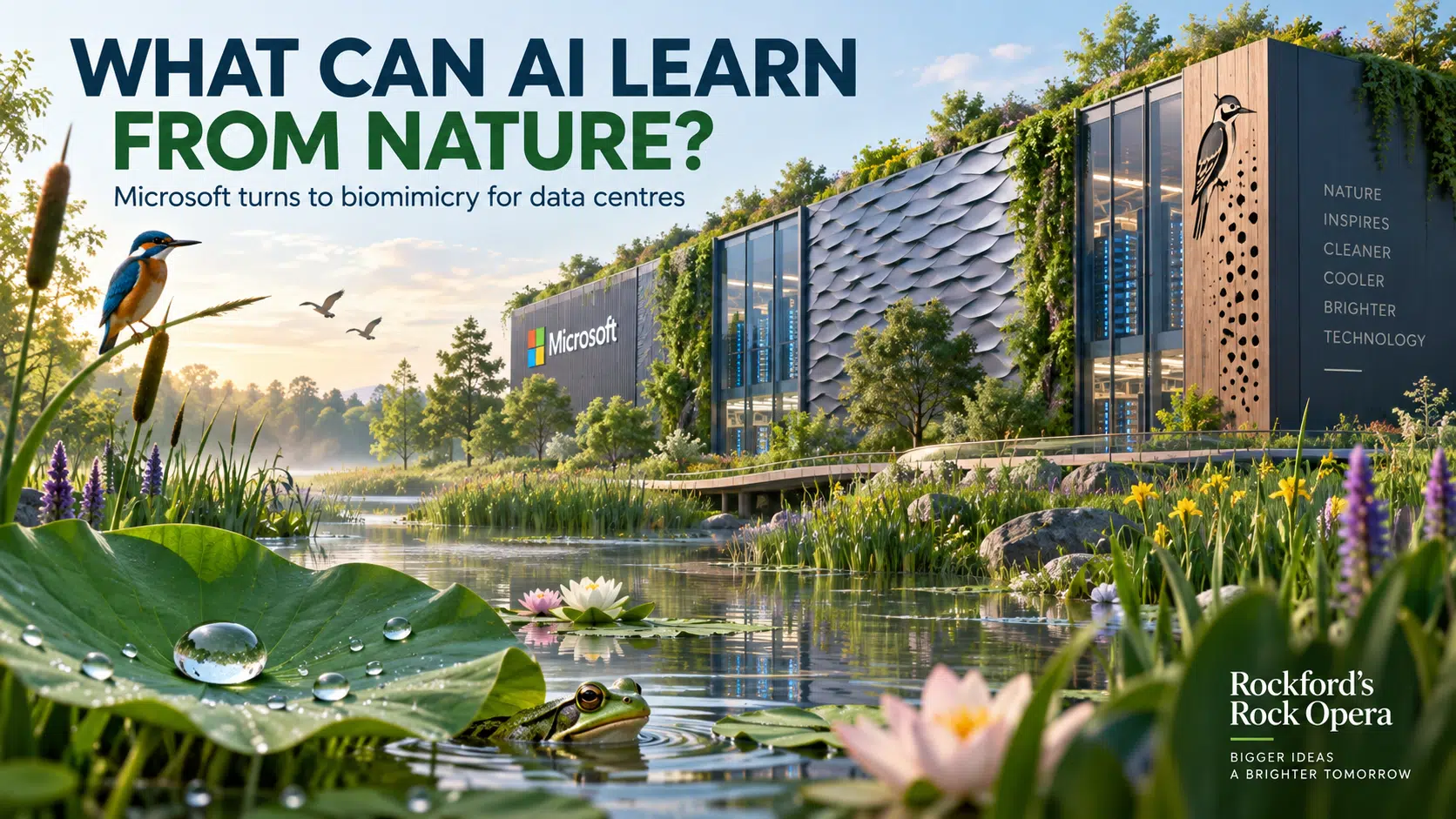
Microsoft has now brought the same principle of learning from nature into the development of some of its data centres.
Data centres are the vast buildings filled with computers that allow us to store information, use cloud services, stream content and increasingly run artificial intelligence systems.
They also require land, energy and cooling, which means there are real questions about how these enormous facilities affect the places where they are built.
Microsoft says it began applying nature-inspired ideas at a data centre near Middenmeer in the Netherlands in 2022.
Instead of treating the land around the building simply as spare space, the team studied how healthy local ecosystems worked.
They looked at native habitats, biodiversity, soil, water and the needs of the local community. Native trees, shrubs, grasses and ground-cover plants were then introduced around the site.
According to Microsoft, that first project included 150 native trees and 2,300 square metres of native greenery.
Now the idea is being expanded.
Wetlands, wildflowers, forests and restored streams
In September 2026, Microsoft announced that its nature-inspired approach was being extended to more than 20 data-centre sites across the United States and Germany. The company says it is also incorporating the approach into all new projects in the USA and a growing number elsewhere.
One of the clearest examples can be found in Mecklenburg County in Virginia.
More than 230 acres of land near a Microsoft data centre have been protected from development.
The project includes:
- eight acres of new wetlands providing habitat for frogs, fish and insects
- restored streams
- more than three miles of walking trails
- 185 acres of restored native pollinator habitat
- more than 25,000 planted trees
In Wisconsin, Microsoft is working with the Root-Pike Watershed Initiative Network to restore wetlands, native prairie and wooded areas beside waterways.
Previously straightened streams are also being returned to more natural, winding shapes. This can improve aquatic habitat, reduce erosion and help filter water before it reaches Lake Michigan.
Projects in Georgia and Germany include native planting, wetland features and connections between habitats that allow wildlife to move between them.
Microsoft describes this work as biomimicry because the aim is to understand how a healthy local ecosystem functions, then use those lessons when designing and restoring the land around its technology.
Can technology measure whether nature is recovering?
There is another interesting twist.
Microsoft is using a tool called Ecosystem Intelligence, running on its Azure cloud technology, to measure factors including biodiversity, water quality and noise reduction.
In other words, technology is being used to help understand whether these nature-inspired designs are actually working.
This matters because planting a few trees beside a huge building and calling it green isn’t enough.
The real question is whether habitats function, wildlife benefits and the local ecosystem becomes healthier.
What about the water used by data centres?
Data centres have also attracted negative attention because some cooling systems use large quantities of water.
Microsoft says that new data centres designed since August 2024 use a closed-loop cooling system in which water is initially added during construction and then circulated repeatedly between servers and chillers rather than continually being consumed for cooling.
The system is already being used at data centres in places including Wisconsin and Georgia.
This is separate from the habitat projects, but it shows how many different environmental questions have to be considered when building the infrastructure behind cloud computing and AI.
We have written more about this on a previous blog, AI in education a growing environmental concern
Nature has been solving problems for a very long time
Artificial intelligence may feel very new.
Nature isn’t.
Life on Earth has been experimenting with materials, structures, movement, chemistry and survival strategies for billions of years.
We have barely begun to understand all of it.
That is why extinction means far more than losing something beautiful.
A creature can disappear before anyone discovers what makes its skin special, how its body fights disease, how it senses its surroundings or what its behaviour could teach an engineer.
Every creature has a secret.
Some of those secrets may one day help us make safer buildings, better medicines, cleaner surfaces, more efficient machines or solve problems we haven’t encountered yet.
So perhaps one of the smartest things humans can do is something children are naturally very good at.
Look closely at the natural world and keep asking questions.
Because the next brilliant human invention might already be crawling, swimming, flying or growing somewhere on Earth.
Explore more Creature Secrets
Discover more than 100 examples of biomimicry, animal adaptations and discoveries inspired by nature in our free Creature Secrets database.

Our ecological adventure stories
Lost on Infinity is a musical adventure story that introduces children to extinction, biodiversity and biomimicry through storytelling and original songs.
Get the Lost on Infinity illustrated book with free musical audiobook – a totally immersive experience.
Listen to the first part of the Lost on Infinity audiobook and watch the animated adventure FREE on Apple App Store and Google Play.
Download our FREE lesson plans and slides about Extinction and Biomimicry. We also have a selection of FREE classroom activities on our website.
For even more exploration of the natural world, tune in to our Stories, Science & Secrets podcast for kids. Join Matthew, Elaine, Steve Punt and special guests, as we delve into the fascinating world of biomimicry and the inspiring ways science learns from nature’s genius.
Every creature has a secret, and every life is precious.
Sources and further reading
- Microsoft: How nature-inspired design is taking root around datacenters, 16 September 2026
- Technology Record: Microsoft adopts biomimicry approach for data centre design, 17 September 2026
- AskNature: Lotus leaf self-cleaning surfaces
- AskNature: Antibacterial surfaces inspired by shark skin
- Current Biology: Woodpeckers minimize cranial absorption of shocks