

How does mistletoe grow? Why did the Druids think it was magical? And where did the Christmas tradition come from?
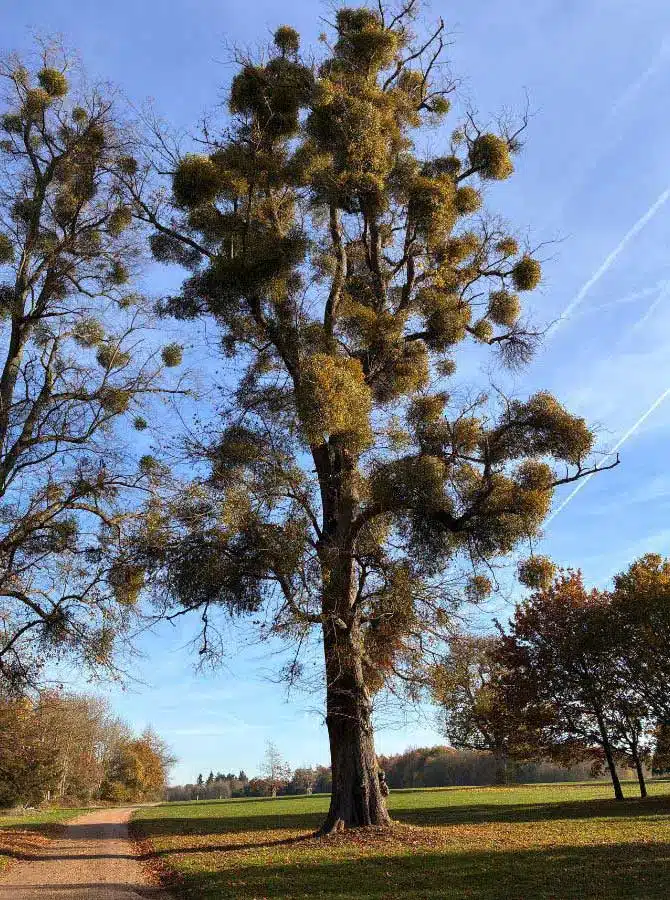
Today we were wandering through the woodlands surrounding Hatfield House in Hertfordshire, and I was amazed by the amount of mistletoe growing in the trees.
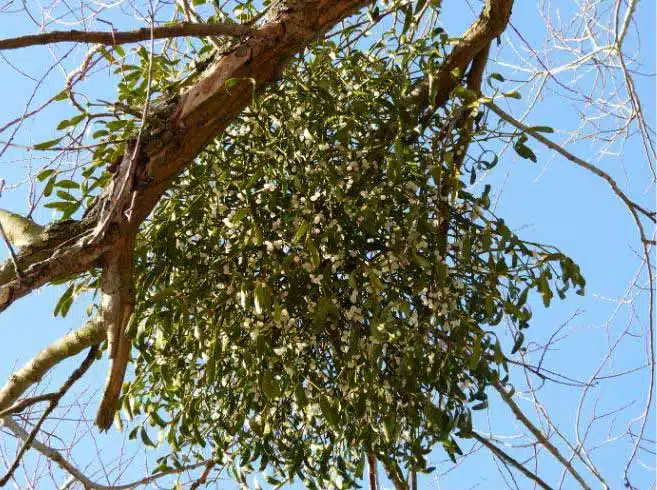
Some of them were absolutely covered in enormous green balls of mistletoe, looking like giant nests suspended among the bare branches.
The photographs accompanying this blog are ones I took on our walk.
It got me thinking about this extraordinary plant. Why was there so much of it here? How did it get up into those trees? And could it grow anywhere a bird happened to leave its droppings?
The answers involve bird poo, sticky seeds, ancient gods, poisonous berries and one of Christmas’s strangest traditions.
Does mistletoe really grow from bird poo?
Yes! Well, sort of.
Mistletoe (Viscum album) produces small white berries that birds eat, particularly mistle thrushes and blackcaps.
Inside each berry is a seed surrounded by an incredibly sticky substance called viscin.
When a mistle thrush eats the berries, the seeds can pass through its digestive system. If the bird leaves its droppings on a suitable tree branch, a seed may stick there and eventually grow.
Blackcaps have a different technique. They eat the berry pulp, then wipe the sticky seeds off their beaks onto branches.
Either way, a new mistletoe plant may eventually develop.
And here’s a strange fact. The name mistletoe may come from old words associated with dung and twigs.
So the plant we hang up for romantic Christmas kisses has a rather less romantic connection to bird poo!
Can mistletoe grow on any tree?
 This was something I wondered as we walked around Hatfield House.
Mistletoe can grow on an extraordinary variety of trees. In Britain, it’s especially fond of apple, lime and poplar trees, but it can also grow on willow, rowan, hawthorn and blackthorn.
In fact, European mistletoe has been recorded growing on hundreds of different types of tree.
It can even grow on some woody shrubs, including hawthorn and blackthorn.
But here’s the catch.
Mistletoe needs a suitable living host.
It’s a partial parasite, meaning it extracts water and minerals from the plant on which it grows. Its own green leaves produce sugars using sunlight, but it can’t survive without its host.
That means it can’t grow on a stone wall, a rooftop or even Churchill’s statue, however many birds leave their droppings there!
A sticky seed might land on the statue and remain attached for a while, but it could never develop into a mature mistletoe plant.
It needs to connect to the living tissues of a suitable tree or shrub.
And surprisingly, although the Druids famously worshipped mistletoe growing on oak trees, oak is one of its least common hosts in Britain.
Why is there so much mistletoe in some places?
This was particularly interesting at Hatfield House, where we saw so many trees covered in it.
Mistletoe is very unevenly distributed across Britain.
It’s particularly abundant in Herefordshire, Worcestershire, Gloucestershire, Somerset and parts of Wales.
One reason is that these areas have traditionally had lots of apple orchards. Apple trees are especially good hosts for mistletoe.
But that doesn’t explain everything.
Mistletoe prefers trees growing in open, sunny places rather than dense, shaded woodland. That’s why it’s so often seen in orchards, parks, gardens and along woodland edges.
Birds also help create local concentrations. Once mistletoe becomes established, birds eating its berries can spread the seeds to neighbouring trees.
Scientists have noticed mistletoe spreading into some new areas of Britain, possibly helped by increasing numbers of blackcaps spending winter here.
So perhaps some of the mistletoe we saw around Hatfield House owes its existence to generations of birds carrying sticky seeds from tree to tree.
Why did the Druids think mistletoe was magical?
 Imagine living thousands of years ago, long before anyone understood how mistletoe grew.
You discover a plant growing high in a tree, apparently without roots. It remains green throughout winter and produces mysterious white berries.
It’s easy to understand why people thought it possessed magical powers.
The ancient Druids regarded mistletoe as sacred.
The Roman writer Pliny the Elder described a ceremony in Gaul in which Druids collected mistletoe from oak trees using a golden sickle.
According to his account, a priest dressed in white climbed the tree and cut the mistletoe, which was caught in a white cloth.
It was believed to have healing powers and to encourage fertility.
The rarity of mistletoe growing on oak trees may have made these particular plants even more special.
Of course, these were ancient beliefs, not scientifically proven properties. Mistletoe is poisonous and should never be eaten.
The Norse legend of mistletoe and the death of a god
Mistletoe also appears in one of the most dramatic stories from Norse mythology.
Baldur was a beloved god, admired for his goodness and beauty.
His mother, Frigg, feared that something terrible would happen to him. To protect her son, she persuaded almost everything in the world to promise never to harm him.
Fire, water, stones, trees and animals all made the promise.
But Frigg overlooked one small plant.
Mistletoe.
The mischievous god Loki discovered this weakness and tricked Baldur’s blind brother, Höðr, into throwing mistletoe at him.
The mistletoe struck Baldur and killed him.
In later retellings, mistletoe became associated with Frigg’s love and sorrow.
It’s an extraordinary journey for a small plant, from a deadly weapon in Norse mythology to a symbol of love at Christmas.
Why do we kiss under mistletoe?
 You might expect this Christmas tradition to stretch back thousands of years.
Surprisingly, there’s no clear evidence that the Druids or ancient Norse people kissed beneath mistletoe.
The custom is documented in Britain from the late 18th century and became increasingly popular during the 19th century.
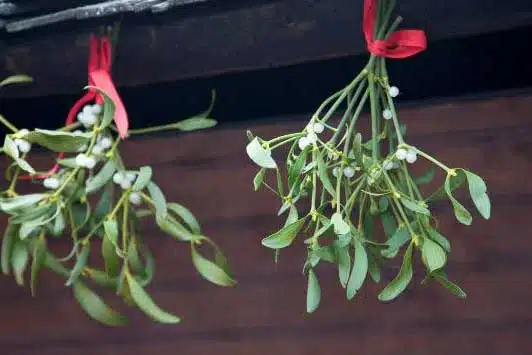
An old tradition involved removing one white berry after every kiss.
Once all the berries had gone, the kissing had to stop!
Nobody knows exactly how the custom began, although mistletoe’s historical associations with love and fertility probably contributed.
A little wildlife world of its own
Mistletoe doesn’t only benefit from birds. It also provides food and shelter for other wildlife.
Its white berries are eaten by mistle thrushes, blackcaps and several other birds.
And some insects have developed an extraordinarily close relationship with mistletoe.
One is the rare mistletoe marble moth, whose tiny caterpillars feed inside the plant’s leaves.
In fact, six insect species in Britain are known to have particularly close associations with mistletoe.
So while mistletoe takes water and minerals from its host, it also helps support other forms of life.
Where can you spot mistletoe this winter?
Winter is the perfect time to go mistletoe spotting.
Once the leaves fall from the trees, those enormous round clumps become much easier to see.
Look upwards when you’re walking through parks, old orchards, churchyards and open woodland.
The West Midlands and the Welsh borders are particularly good places to look, but you can find mistletoe in many other parts of southern England too.
And judging by our walk today, the woodlands and parkland around Hatfield House are well worth keeping an eye on!
Rockford’s Christmas nature challenge
Next time you’re out for a winter walk, look up into the branches of the trees.
Can you spot a giant green ball of mistletoe?
See if you can identify the tree it’s growing on.
And if you spot a mistle thrush nearby, remember that it might be helping to plant the next generation of mistletoe.
One little berry, one sticky seed and one very helpful bird.
It’s quite a story for a plant we usually only notice at Christmas.
Remember: mistletoe berries and leaves are poisonous. Enjoy spotting the plant, but don’t eat it. Keep Christmas decorations containing mistletoe away from children and pets.
NEW! Rockford’s Monthly Guide to British Nature Is Here!
From the surprising lives of familiar animals to the hidden secrets of our woods, gardens and countryside, Rockford’s Monthly Guide to British Nature takes families on a journey through twelve months of wildlife discoveries, seasonal activities and nature challenges.
 Inspired by the wonderful response to our monthly nature guides, we’ve created a beautifully illustrated, full-colour book that takes children on a journey through an entire year of British wildlife.
Join Rockford, the adventurous dog from our adventure story Lost on Infinity, as he discovers what to look for each month, from winter wildlife and spring flowers to summer butterflies, autumn fungi and the extraordinary secrets of the natural world.
Packed with fascinating animal facts, outdoor challenges, seasonal activities, nature journal pages and discoveries about biomimicry, it’s designed to encourage children aged 5–11 to get outside, look more closely and develop a lasting love of nature.
Perfect for families, grandparents, home educators and classrooms, it’s a book children can return to throughout the year.
Available now for £9.99, with free UK delivery.
Discover Rockford’s Monthly Guide to British Nature and order your copy
Discover more through our ecological adventure stories

Lost on Infinity is a musical adventure story that introduces children to extinction, biodiversity and biomimicry through storytelling and original songs.
Get the Lost on Infinity illustrated book with free musical audiobook, creating an immersive read-along experience.
Listen to the first part of the Lost on Infinity audiobook and watch the animated adventure FREE on the Apple App Store and Google Play.
Download our FREE lesson plans and slides about Extinction and Biomimicry. We also have a selection of FREE classroom activities on our website.
For even more exploration of the natural world, tune in to our Stories, Science & Secrets podcast for kids. Join Matthew, Elaine, Steve Punt and special guests as we explore biomimicry and the ways science learns from nature.
Every creature has a secret and every life is precious.