
Deep in the evergreen forests of Southeast Asia lives a secretive mammal that most people cannot name. Owston’s civet is a shy, nocturnal creature that slips silently through dense undergrowth. Few people have ever seen one. Fewer still recognise its name.
Civets are small cat-like carnivorous mammals belonging to the Viverridae family, a group that includes genets, binturongs, and oyens. Owston’s civet sits among the rarer and least-known members of this family. Linsangs, although similar in appearance, belong to a separate family, Prionodontidae.
What Are Civets?
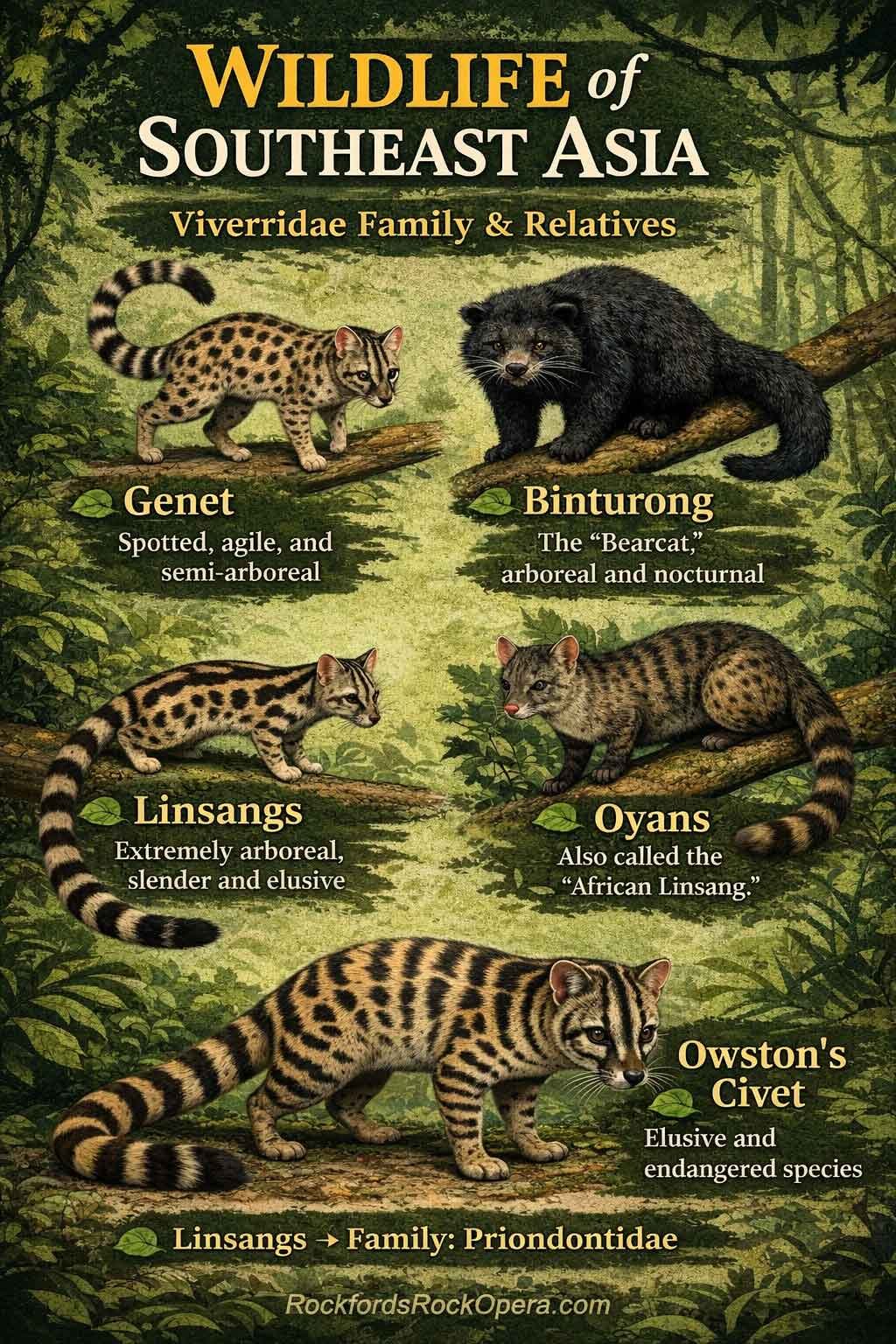 We created this poster to show how civets differ in appearance. Civets are mammals found mainly in Africa and Asia, with a few relatives extending into Europe. They typically have:
• Slender bodies
• Pointed faces
• Long tails
• Nocturnal habits
Civets form their own distinct branch of carnivorous mammals.
This species varies widely in size, appearance, habitat, and behaviour. Some are common and adaptable. Others are rare and highly specialised. Some tolerate human-altered landscapes. Others depend on intact wilderness.
Civets communicate using a mixture of sounds and scent signals. Growls, hisses, and calls are common, alongside scent marking. Many civet species also display striking coat patterns, ranging from bold stripes to spots and bands.
There are around 15 to 20 recognised civet species, native to Africa and Asia. They occupy a wide range of habitats, including forests, woodlands, and savannahs.
Civets play an important ecological role. Many species eat fruit and disperse seeds through their droppings. This helps regenerate forests. Their decline can disrupt entire ecosystems.
🐾🍃🌾🐾🍃🌾🐾🍃🌾🐾🍃🌾🐾🍃🌾🐾🍃🌾🐾🍃🌾🐾🍃🌾🐾🍃🌾
Owston’s Civet: A Detailed Profile
Scientific name: Chrotogale owstoni
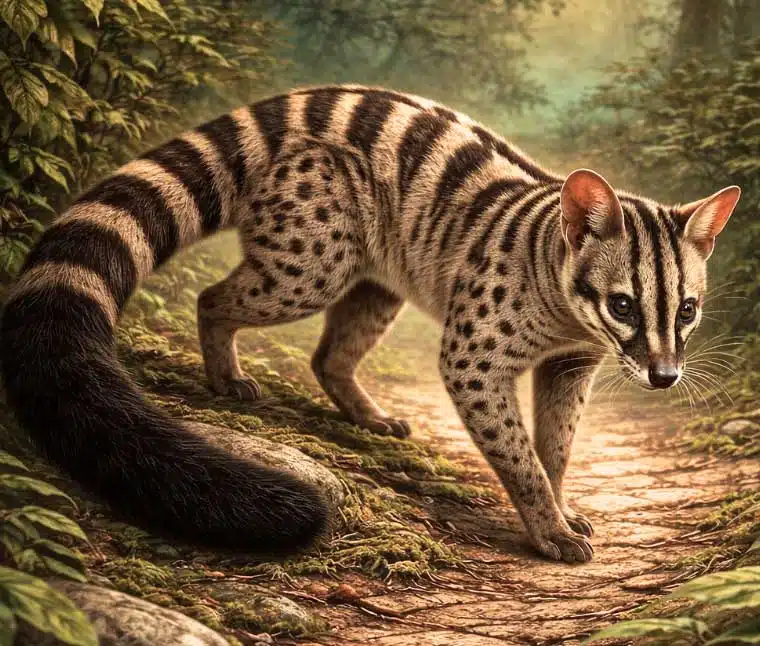 Owston’s civet is a small, slender carnivorous mammal native to parts of Vietnam, Laos, and southern China. Like other civets, it has an elongated body, pointed muzzle, and long tail. Yet its details are distinctive as you can see from our illustration above.
Its coat is especially striking. A grey-buff background marked with bold black spots and dark stripes along the neck. The markings appear sharp and graphic, giving the animal a finely patterned appearance.
This differs noticeably from:
• Asian palm civets, which are often plainer brown or grey
• Masked palm civets, recognised by facial markings
• African civets, which are larger and stockier with heavier banding
Owston’s civet is also notably slender and delicate in build. Designed for moving quietly through dense forest vegetation.
Habitat preference is one of its defining traits. Owston’s civet is strongly tied to dense evergreen forests. It is a forest specialist. Many other civet species are far more adaptable and can live near farms or settlements.
Behaviourally, Owston’s civet is nocturnal, solitary, and elusive. It spends much of its time on the forest floor rather than climbing trees like some palm civets.
Diet and Feeding Behaviour
Owston’s civet is omnivorous. Its diet includes:
• Small mammals
• Insects and worms
• Fruits
• Birds’ eggs
It forages at night, using keen senses to locate food in leaf litter and undergrowth.
Why Is This Species at Risk?
Owston’s civet faces several pressures:
• Habitat loss from deforestation
• Hunting
• Wildlife trade
Because it depends on intact forest, it struggles to survive in fragmented landscapes. Precise current population numbers are not confirmed, as estimates vary.
🐾🍃🌾🐾🍃🌾🐾🍃🌾🐾🍃🌾🐾🍃🌾🐾🍃🌾🐾🍃🌾🐾🍃🌾🐾🍃🌾
Is Owston’s Civet the Same as Other Civets?
No. civets are a group of related but distinct species, mostly within the Viverridae family. Each species has its own evolutionary path, habitat, and ecological role. Extinction removes something unique.
Owston’s Civet Compared With Other Civets
| Feature | Owston’s Civet | Asian Palm Civet | Masked Palm Civet | African Civet |
|---|---|---|---|---|
| Scientific name | Chrotogale owstoni | Paradoxurus hermaphroditus | Paguma larvata | Civettictis civetta |
| Markings | Spots + neck stripes | Usually plain brown or grey | Pale facial mask | Bold bands + spots |
| Build | Slender, delicate | Soft, rounded | Lean, agile | Large, stocky |
| Typical habitat | Dense evergreen forest | Forests + human edges | Woodland + disturbed areas | Savannah + woodland |
| Lifestyle | Nocturnal, ground-dwelling | Nocturnal, tree-climbing | Nocturnal, agile climber | Nocturnal, terrestrial |
See the IUCN Red List for detailed listings.
 Why Do Civets Matter?
 Why Do Civets Matter?
Civets play quiet but vital ecological roles. Seed dispersal. Pest regulation. Food web balance. Remove civets, and subtle imbalances begin to appear.
Why Are Lesser-Known Animals Important?
Conservation attention often centres on headline species. Tigers. Elephants. Pandas. Yet biodiversity depends on countless lesser-known animals working behind the scenes. Owston’s civet is one such species.
Here Are Some of the Threats Civets Face
The civet coffee industry
Some civets, particularly common palm civets, are caged and fed coffee cherries. The beans are collected from their droppings to produce civet coffee. This often involves confinement and stress. Civet coffee is seen as a delicacy in some parts of the world and is also known as Kopi Luwak (in Indonesia) and Weasel Coffee (in Vietnam). Civet coffee can command extremely high prices, sometimes hundreds of dollars per cup.
Civet musk exploitation
Species such as the African civet have historically been farmed or captured for musk used in perfumes.
Wildlife trade
Civets are sometimes sold as exotic pets.
Habitat destruction
Deforestation reduces and fragments civet habitats.
Hunting
Snares and dogs are used in some regions. Civet meat is considered a delicacy in parts of Asia.
Are There Charities Helping Endangered Civets?
Civets benefit from broader wildlife conservation efforts. Organisations active in habitat protection and anti-poaching work include: The Civet Project and Wildlife Conservation Network
World Civet Day is held on 4th April, you can read more about ways to support them on the The Civet Project website. World Civet Day is a celebration of civets, oyans and genets. Together, we will raise awareness of these often overlooked species and highlight the fundamental role they naturally play in protecting the health of wildlife, people and the planet. By celebrating civets we will instill unwavering pride in civet species and collectively commit to their protection!
For more ideas on connecting with nature, visit Rockford’s Rock Opera and explore the stories that inspire curiosity and imagination.
🎶🐾💚📚🎶🐾💚📚🎶🐾💚📚🎶🐾💚📚🎶🐾💚📚🎶🐾💚📚🎶🐾💚📚🎶🐾💚📚🎶🐾💚📚🎶🐾💚📚
Discover more through story and song
Get the Lost on Infinity illustrated book with free musical audiobook – a totally immersive experience.
Listen to the first part of the Lost on Infinity audiobook and watch the animated adventure FREE on Apple App Store and Google Play.
Download our FREE lesson plans and slides about Extinction and Biomimicry. We also have a selection of FREE classroom activities on our website.
For even more exploration of the natural world, tune in to our Stories, Science & Secrets podcast for kids. Join Matthew, Elaine, Steve Punt and special guests, as we delve into the fascinating world of biomimicry and the inspiring ways science learns from nature’s genius.