

The dodo is one of the best known extinct animals. Yet the real story is often misunderstood. The dodo was not silly or slow. It was a perfectly adapted island bird. It lived safely for thousands of years. Then humans arrived.
Within less than a century, the species had vanished.
Understanding the dodo helps us understand extinction itself. Not as something distant. Something real. Something still happening.
What was the dodo?
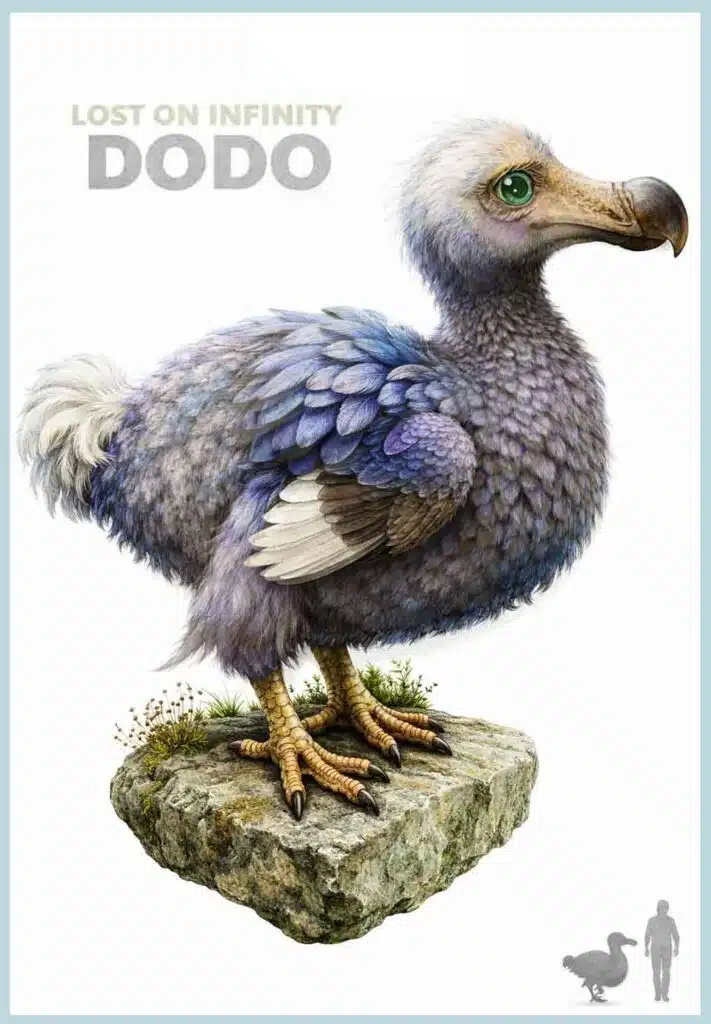
The dodo (Raphus cucullatus) lived exclusively on the island of Mauritius, a lush volcanic speck in the Indian Ocean roughly 900 km east of Madagascar. A member of the pigeon and dove family — its closest living relative is the Nicobar pigeon, it had evolved over millions of years in complete isolation, growing large, losing its ability to fly, and shedding its fear of predators. There were none.
That fearlessness, so often mocked as stupidity, was not a design flaw. It was a rational adaptation to a predator-free world. The dodo had no evolutionary reason to run. Until, suddenly, it did.
Key facts
- Height about 1 metre
- Weight estimated 10 to 18 kg
- Diet included fruit seeds roots and small animals
- Closest relatives are pigeons and doves
- Habitat was coastal forest
A 64-year extinction
Dutch sailors first recorded the dodo in 1598, describing it with a mixture of curiosity and appetite. Within 64 years, the species was gone. That is not a slow decline, it is a collapse.
Why the dodo vanished
Hunting played a role — dodos were easy to approach and kill — but it was likely not the primary cause. The more destructive force was the ecosystem of animals that arrived alongside humans.
-
Rats, pigs, cats, and macaques ate dodo eggs and chicks directly from ground-level nests. The dodo had never evolved defences against nest predation.
-
Colonial settlement cleared the coastal forests the dodo depended on, fragmenting its range and destroying food sources.
-
Dodos were killed for meat by sailors and settlers. Because they showed no fear, they could be walked up to and struck with clubs.
-
Like most large birds, dodos likely raised only one chick per year. Once losses exceeded the birth rate, recovery became mathematically impossible.
Have a look at the Dodo Field Guide in our Character section.
Why the dodo still matters
The dodo became a cultural shorthand for foolishness — “dead as a dodo,” something absurd and doomed. And yet, the dodo was a successful species for millions of years. Humans destroyed it in six decades.
Today, scientists study the dodo partly to understand how island species – disproportionately vulnerable to extinction – can be protected. The same pressures that killed the dodo are still operating, at scale.
Each extinct species represents a unique evolutionary lineage – millions of years of adaptation, irreversibly lost. Beyond the philosophical loss, extinction closes off practical possibilities. Scientists study biological structures and systems as models for human design and medicine, a field called biomimicry. A lost species is a lost library.
Telling the dodo’s story accurately matters because the myth of the stupid, doomed bird lets us off the hook.
The real story does not.
Listen to our latest song inspired by the dodo.
We will continue writing about these lost creatures.
Discover more through story and song
 Get the Lost on Infinity illustrated book with free musical audiobook – a totally immersive experience.
Listen to the first part of the Lost on Infinity audiobook and watch the animated adventure FREE on Apple App Store and Google Play.
Download our FREE lesson plans and slides about Extinction and Biomimicry. We also have a selection of FREE classroom activities on our website.
For even more exploration of the natural world, tune in to our Stories, Science & Secrets podcast for kids. Join Matthew, Elaine, Steve Punt and special guests, as we delve into the fascinating world of biomimicry and the inspiring ways science learns from nature’s genius.
Every creature has a secret, and every life is precious.
About the creators:
Elaine Sweetapple is an illustrator and co-creator of Rockford’s Rock Opera, writing about nature, biomimicry, and storytelling.
Matthew Sweetapple is a writer and producer of Rockford’s Rock Opera, focusing on adventure-led environmental narratives.
Steve Punt is a writer and broadcaster, known for his work across BBC radio and television, and co-creator of Rockford’s Rock Opera.
Rockford’s Rock Opera adventures are written by professional writers, illustrated by artists, and recorded by real musicians, actors and producers. Crafted by humans, the hard way 🎶😊💚