

Could humans survive without animals?
Probably not for very long.
Humans depend on animals in ways that are both obvious and hidden.
Without pollinators, many crops would fail.
Without marine ecosystems, oxygen production and climate balance would be affected.
Without soil organisms and food chains, agriculture would begin to collapse.
Even animals we rarely notice help control disease, recycle nutrients, and maintain the ecosystems that keep water, soil, and air stable.
Some scientists believe humans could survive for a short time using technology, artificial farming, and stored resources.
But civilisation as we know it would begin to break down very quickly.
The exact timeline is impossible to confirm because ecosystems are deeply interconnected. Different systems would fail at different speeds.
But one thing is clear. If the natural world collapses, humanity does not stand outside it.
We collapse with it.
What Keeps the Planet Alive?
A bee on a flower.
A vulture in the sky.
A sea otter floating on its back.
They look like small moments.
They are not.
They are the systems that keep the planet working.
The collapse would not start with a bang
It would start quietly.
One species disappears.
Then another.
Then another.
That is already happening.
Many scientists describe today as part of a possible sixth mass extinction, a period when species are being lost far faster than the natural background rate. I cannot confirm an exact number or final outcome, because this is still unfolding. But the trend is widely recognised by groups like the IUCN.
This is not one event. It is a process.
And the danger is in the chain reaction.
What if all the insects disappeared?
It is easy to think of insects as small and insignificant. But remove them and the effects would spread through almost every ecosystem on Earth.
Insects pollinate plants, recycle nutrients and provide food for countless other creatures.
Birds are a good example. Many species depend heavily on insects, particularly when feeding their young. Remove the insects and suddenly the birds have a problem. Then the animals that depend on those birds have a problem too.
And the effects would reach us.
Many of the crops we rely on benefit from animal pollination. Without pollinators, foods including many fruits, vegetables, nuts, coffee and cocoa would become much harder to produce.
So losing insects would not simply mean fewer butterflies, bees and beetles.
It would mean losing some of the tiny workers that help keep the whole system running.
Another thread disappears.
Then another part of the web begins to unravel.
What happens when a keystone species disappears?
Case study 1: Sea otters and the collapse of kelp forests
 The Sea otter is a keystone species. That means its role is far bigger than its size.
Sea otters eat sea urchins and sea urchins eat kelp.
Kelp forests are underwater cities we need to protect them. They provide shelter, food, and protection for hundreds of species.
Remove the otter and Sea urchins multiply quickly. They overgraze the kelp then the forests disappear.
What is left is called an “urchin barren”. A seafloor stripped of life.
What that means
- Fish lose habitat
- Biodiversity collapses
- Coastal protection weakens
- Carbon storage drops
One predator gone can mean an entire ecosystem is reshaped.
Read our previous blog Animals that have Defied Extinction.
Case study 2: What would happen if vultures disappeared?
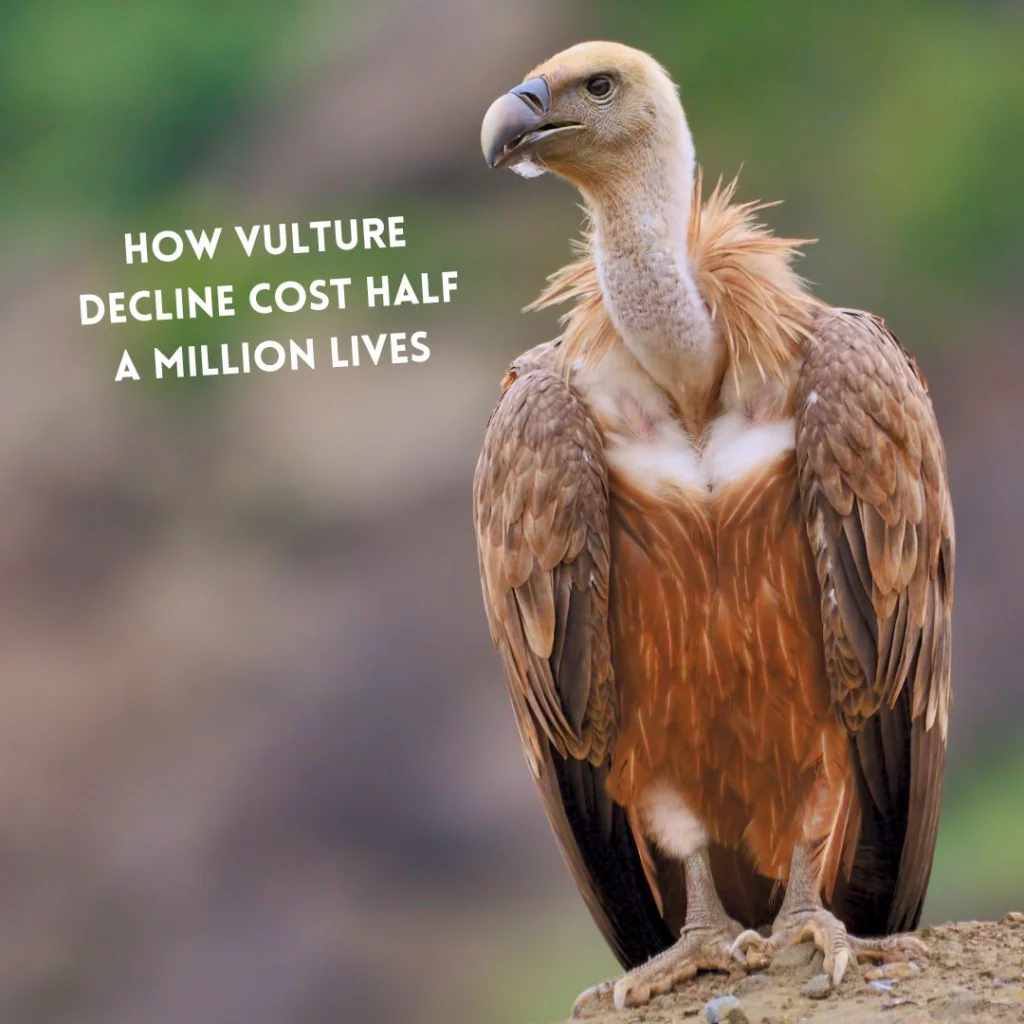
In India, populations of vultures, including the White-rumped vulture, crashed by over 95 percent in the 1990s.
The cause was a drug used in livestock.
If you remove the scavenger, carcasses are no longer cleared quickly. Feral dog populations increased. Rabies spread more easily.
This actually happened, and you can read more about it our previous blog: How decline of Indian vultures led to 500,000 human deaths
Studies link this ecological change to a major public health impact, including thousands of additional human deaths over time due to rabies. The link between vulture decline and rising disease risk is well established.
Nature’s Life Support System
We all understand bees.
Remove pollinators like the Western honey bee and:
- many crops fail
- wild plants decline
- food chains weaken
That is one group.
But what if we lose another keystone species?
Not bees. Something less obvious.
- Predator that keeps balance
- Grazer that shapes landscapes
- Marine giant that moves nutrients
Case study 3: What if whales disappeared?
Large whales help fertilise the ocean.
Their movement and waste bring nutrients to the surface, feeding tiny plants called phytoplankton.
Phytoplankton:
- produce a significant portion of the Earth’s oxygen
- absorb carbon dioxide
- form the base of marine food webs
Remove the whales
- nutrient cycling weakens
- phytoplankton declines
- food chains are affected
- carbon balance shifts
It isn’t an instant collapse, but the system weakens. So how would it really happen?
Not all animals vanish at once. Instead:
- one species disappears
- systems adjust
- another disappears
- systems weaken
Each loss makes the next more likely. This is what makes mass extinction dangerous. It is the loss species which means the loss of connections.
In our adventure story, Lost on Infinity, each extinct species leaves a mark in the Fossil Record Office.
A final trace.
But each trace could also represent a missing function.
- Pollinator that once fed forests.
- Predator that once protected ecosystems.
- Giant that once helped regulate the oceans.
Infinity becomes more than a record.
It becomes a map of how the world once worked.
One final thought
In Lost on Infinity, the disappearance begins with dogs. When Rockford is accidentally checked into the Fossil Record Office, dogs across Earth begin to vanish. At first, the loss feels personal. Pets disappear, companions vanish, and chaos spreads across the world.
But the real danger is bigger than losing the animals we love.
Extinction is never just about one species. Every creature is connected to something larger. Some pollinate forests. Some control disease. Some shape landscapes or help regulate the oceans. Remove one thread and the system weakens. Remove enough, and the balance that supports life begins to break apart.
That is why protecting nature matters so much. The good news is that ecosystems can recover when species are protected and habitats are restored. We have already seen whales return to some oceans, wolves reshape damaged environments, and endangered species recover when people choose to act.
The future is not written yet.
Discover more through our stories
Lost on Infinity is a musical adventure story that introduces children to extinction, biodiversity and biomimicry through storytelling and original songs.
Get the Lost on Infinity illustrated book with free musical audiobook – a totally immersive experience.
Listen to the first part of the Lost on Infinity audiobook and watch the animated adventure FREE on Apple App Store and Google Play.
Download our FREE lesson plans and slides about Extinction and Biomimicry. We also have a selection of FREE classroom activities on our website.
For even more exploration of the natural world, tune in to our Stories, Science & Secrets podcast for kids. Join Matthew, Elaine, Steve Punt and special guests, as we delve into the fascinating world of biomimicry and the inspiring ways science learns from nature’s genius.
Every creature has a secret, and every life is precious.
About the creators:
Elaine Sweetapple is an illustrator and co-creator of Rockford’s Rock Opera, writing about nature, biomimicry, and storytelling.
Matthew Sweetapple is a writer and producer of Rockford’s Rock Opera, focusing on adventure-led environmental narratives.
Steve Punt is a writer and broadcaster, known for his work across BBC radio and television, and co-creator of Rockford’s Rock Opera.