

 Deep in the forests of Timor lives one of the world’s least known pigeons. Most people have never heard of it. Few have ever seen it. Yet scientists now warn that the beautiful Timor green pigeon may be sliding rapidly towards extinction.
The story is deeply worrying because it follows a pattern conservationists know all too well. A species that once seemed secure slowly disappears from parts of its range. Numbers fall quietly. Forests become fragmented. Hunting pressure increases. Sightings become rare. Then suddenly scientists realise there may only be a few hundred animals left.
By that stage, time is dangerously short. The Timor Green Pigeon Could Soon Vanish Forever. History Has Seen This Before.
For us at Rockford’s Rock Opera, the story feels hauntingly familiar. In our story Lost on Infinity, one of the extinct birds living on the Island of Infinity is Iggy, the last passenger pigeon. His species once filled the skies of North America in numbers so vast they were almost beyond imagination. Yet humans drove them to extinction within a few decades.
The Timor green pigeon may now be facing a similar fate.
What is the Timor green pigeon?
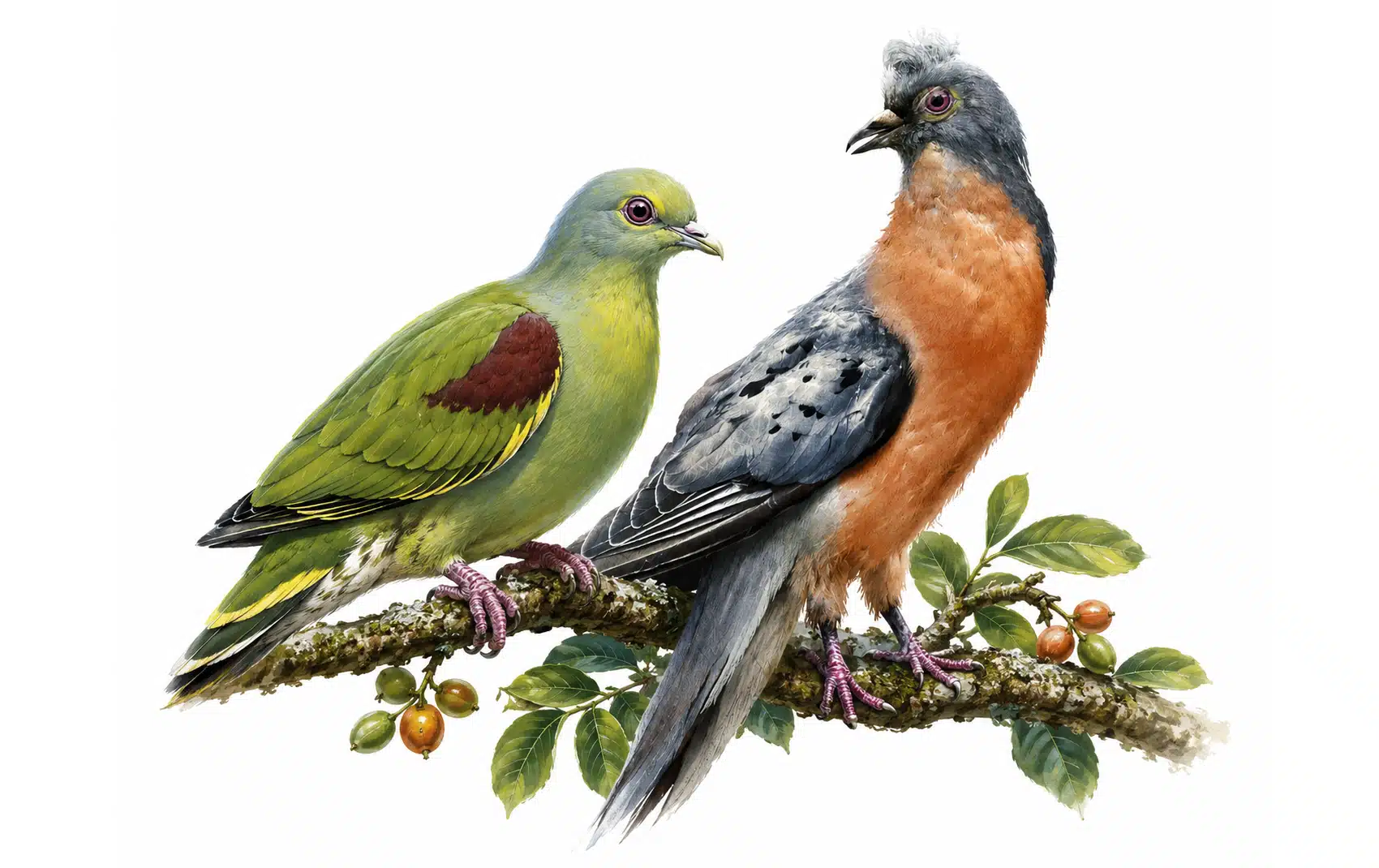 The Timor green pigeon, scientifically known as Treron psittaceus, is a rare fruit-eating pigeon found on Timor and nearby Indonesian islands. Unlike the grey pigeons many people see in towns and cities, this species is brilliantly coloured with vivid green plumage, soft yellow tones and elegant maroon markings.
Its colouring acts as camouflage among tropical leaves and fruiting trees. Even experienced birdwatchers can struggle to spot one.
Green pigeons play an important role in forest ecosystems. As they feed on fruit, they spread seeds through the forest. This helps maintain healthy woodland and supports plant diversity. In many tropical ecosystems, pigeons are silent gardeners of the forest.
If they disappear, forests lose part of their natural regeneration system.
Why are scientists so worried?
A recent study highlighted by Rare Bird Alert website estimates that only around 100 to 500 Timor green pigeons may remain in the wild.
That is an incredibly small population for a bird spread across several islands.
Researchers also found something even more concerning. In many places where the birds were once regularly observed, they now appear to have disappeared completely. Some forests that historically supported populations have recorded no sightings for decades.
Scientists fear the species could now be locally extinct across large parts of its former range.
When populations become fragmented like this, survival becomes much harder.
A small isolated group of birds may struggle because:
- Fewer birds means less breeding success
- Disease can spread more easily
- Genetic diversity declines
- Extreme weather events become more dangerous
- Hunting pressure affects a larger percentage of the population
Once numbers become critically low, even small changes can push a species beyond recovery.
Hunting may be the biggest threat
One of the main causes of decline appears to be hunting.
Fruit pigeons are particularly vulnerable because they often gather together at feeding trees. Hunters know where these trees are located and can easily target birds as they arrive.
Researchers also observed a tragic behavioural problem. When one pigeon is shot, nearby birds sometimes remain in the area instead of immediately escaping. This makes it easier for multiple birds to be killed at once.
The same behaviour contributed to the extinction of the passenger pigeon.
Passenger pigeons once travelled in gigantic flocks numbering billions. Early accounts described skies darkening overhead for hours as birds passed by. The noise of their wings reportedly sounded like thunder.
Yet those enormous flocks became their downfall.
Hunters could kill vast numbers quickly because the birds remained tightly grouped together. At the same time, industrialisation brought railways and telegraph systems that allowed commercial hunting operations to target colonies with terrifying efficiency.
People assumed such huge numbers could never disappear.
They were wrong.
The terrifying speed of extinction
The extinction of the passenger pigeon remains one of the greatest conservation warnings in history.
At one point, passenger pigeons may have represented up to 40% of all birds in North America. Estimates suggest there were between three and five billion individuals.
Then everything changed.
Mass hunting destroyed huge numbers every year. Forest destruction removed nesting habitat. Breeding colonies collapsed. By the late 1800s, the species had entered catastrophic decline.
The last known wild passenger pigeon was shot in 1901.
The last living bird, Martha, died in Cincinnati Zoo in 1914.
The entire species vanished within a human lifetime.
That story matters because it shows extinction is not always slow. Sometimes populations collapse suddenly once they fall below a critical point. Scientists call this an extinction vortex. As numbers shrink, survival becomes harder and decline accelerates.
The Timor green pigeon may now be entering that dangerous stage.
Why pigeons matter more than people realise
Pigeons often suffer from an image problem.
Many people associate them only with urban birds scavenging for crumbs in city centres. Yet pigeons and doves are among the most ecologically important birds on Earth.
Many species disperse seeds across huge distances. Some tropical trees rely almost entirely on birds like pigeons to spread their seeds.
Without them, forests can slowly change.
Scientists studying island ecosystems have repeatedly found that when seed-dispersing birds disappear, certain tree species also decline over time.
That means the extinction of one bird can create ripple effects through entire ecosystems.
Nature works like a web.
Remove one strand and the structure weakens.
Remove enough strands and the whole system can begin to fail.
Could the Timor green pigeon still be saved?
There is still hope, but scientists stress that urgent action is needed now.
Conservation groups are calling for:
- Better forest protection
- Stronger anti-hunting measures
- Community education programmes
- Improved population monitoring
- Protection of remaining feeding and nesting areas
One encouraging sign is that some of the strongest remaining populations appear to survive in remote forest areas of Timor-Leste.
Protecting those habitats could be critical.
Conservation history shows that rapid intervention can work. Species once thought close to extinction, including the Mauritius kestrel and California condor, have recovered through determined conservation programmes.
But success depends on acting before numbers fall too low.
You can read the report on Cambridge University website.
What does this have to do with Lost on Infinity?
In Lost on Infinity, extinct species are not forgotten. They continue to exist on the Island of Infinity, carrying the memory of what humanity lost.
Iggy the passenger pigeon represents a real warning from history. He is not just a fictional bird, he symbolises how quickly humans can destroy even the most abundant species on Earth.
The Timor green pigeon reminds us that extinction is not only something from the past. It is happening right now. Children growing up today may become the generation that decides whether species like this survive. Stories can help make that connection real.
Facts alone sometimes feel distant. But when children emotionally connect with animals through stories, songs and characters, they begin to understand why protecting nature matters.
That is one reason extinction education is so important. Because once a species disappears, there is no bringing it back. The forest simply becomes quieter.
________________________________________________________________________
Discover more through our stories
Lost on Infinity is a musical adventure story that introduces children to extinction, biodiversity and biomimicry through storytelling and original songs.
Get the Lost on Infinity illustrated book with free musical audiobook – a totally immersive experience.
Listen to the first part of the Lost on Infinity audiobook and watch the animated adventure FREE on Apple App Store and Google Play.
Download our FREE lesson plans and slides about Extinction and Biomimicry. We also have a selection of FREE classroom activities on our website.
For even more exploration of the natural world, tune in to our Stories, Science & Secrets podcast for kids. Join Matthew, Elaine, Steve Punt and special guests, as we delve into the fascinating world of biomimicry and the inspiring ways science learns from nature’s genius.
Every creature has a secret, and every life is precious.
________________________________________________________________________
About the creators:
Steve Punt is a writer and broadcaster, known for his work across BBC radio and television, and co-creator of Rockford’s Rock Opera.
Matthew Sweetapple is a writer and producer of Rockford’s Rock Opera, focusing on adventure-led environmental narratives.
Elaine Sweetapple is an illustrator and co-creator of Rockford’s Rock Opera, writing about nature, biomimicry, and storytelling.
Rockford’s Rock Opera adventures are written by professional writers, illustrated by artists, and recorded by real musicians, actors and producers. Crafted by humans, the hard way 🎶😊💚