

Why do audiobooks help children learn more effectively?
Audiobooks are becoming a powerful tool in classrooms and homes. Instead of replacing reading, they support it. Children who listen to stories often build stronger vocabulary and better understanding of language patterns. They also stay engaged for longer, especially when the story includes music and sound.
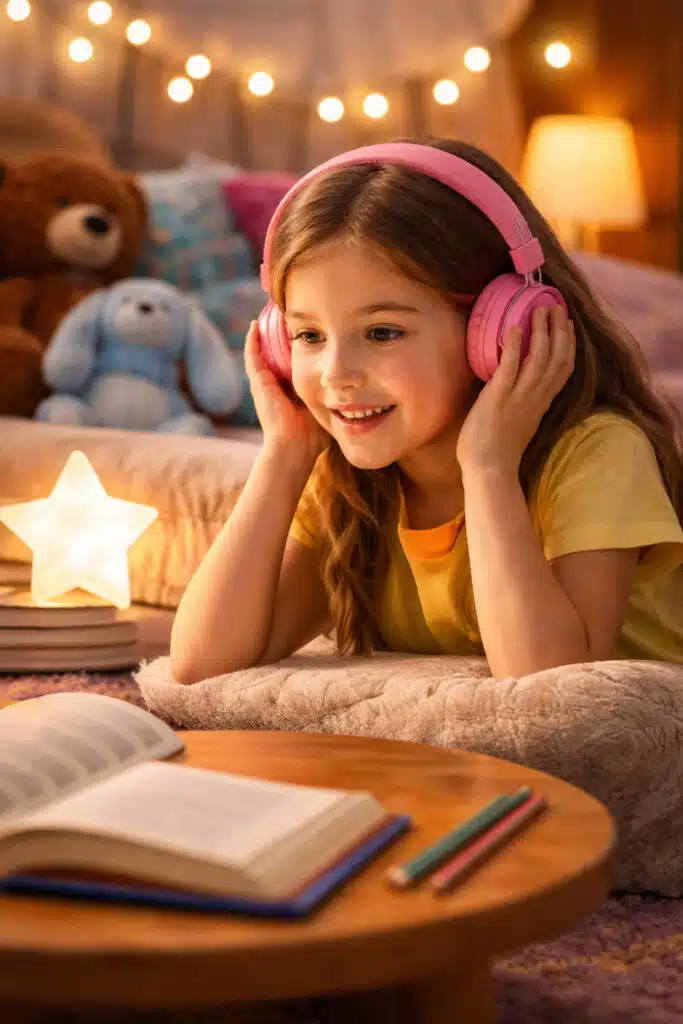
What happens in the brain when children listen?
Studies from universities including University College London have shown that listening to stories activates many of the same brain areas as reading. These include regions linked to language, memory, and visual imagination. This means children are not passively hearing a story. They are actively building it in their minds.
According to research shared by the BBC, listening can also reduce pressure for reluctant readers. As a result, children who struggle with text can still access complex ideas and stories.
Can audiobooks improve reading skills?
Yes, when used alongside books. Hearing correct pronunciation and sentence flow helps children recognise patterns in language. Over time, this can support reading confidence. Teachers often use audiobooks to introduce new texts before children read them independently.
Why does sound make stories more engaging?
Sound adds emotion and atmosphere. Music, voices, and effects help children feel the story. This can improve memory because emotional experiences are easier to recall. It also keeps attention, which is vital in a classroom setting. With the dawn of Ai audiobooks will be easier to access, you can read more in our previous article How will Ai affect Audiobooks.
How can teachers and parents use audiobooks?
- Play audiobooks during quiet reading time
- Use them to introduce new topics
- Encourage children to draw what they hear
- Combine listening with reading the same book
These simple steps can turn listening into an active learning experience.
Where does immersive storytelling fit in?
Immersive audiobooks take this further. They use layered sound, music, and character voices to create a full experience. This approach can deepen engagement and help children connect emotionally with the story.
You can explore an example of immersive storytelling through Rockford’s Rock Opera, where sound and music are used to tell stories about nature and extinction.
Discover more through story and song
Lost on Infinity is a musical adventure story for children. It explores extinction, biodiversity and biomimicry through storytelling and original songs.
You can get the Lost on Infinity illustrated book with a free musical audiobook. It is designed to be a rich and immersive experience.
You can also listen to the first part of the audiobook and watch the animated adventure for free on the Apple App Store and Google Play.
We also offer free lesson plans and slides on extinction and biomimicry. You can also find more free classroom activities on our website.
For more ideas, explore the Stories, Science & Secrets podcast for kids. Each episode looks at how nature inspires science and storytelling.
Every creature has a secret. Every life is precious.
About the creators
Elaine Sweetapple is an illustrator and co-creator of Rockford’s Rock Opera. She writes about nature, biomimicry and storytelling.
Matthew Sweetapple is a writer and producer. He focuses on adventure-led environmental stories.
Steve Punt is a writer and broadcaster. He is known for his work on BBC radio and television. He is also a co-creator of Rockford’s Rock Opera.